



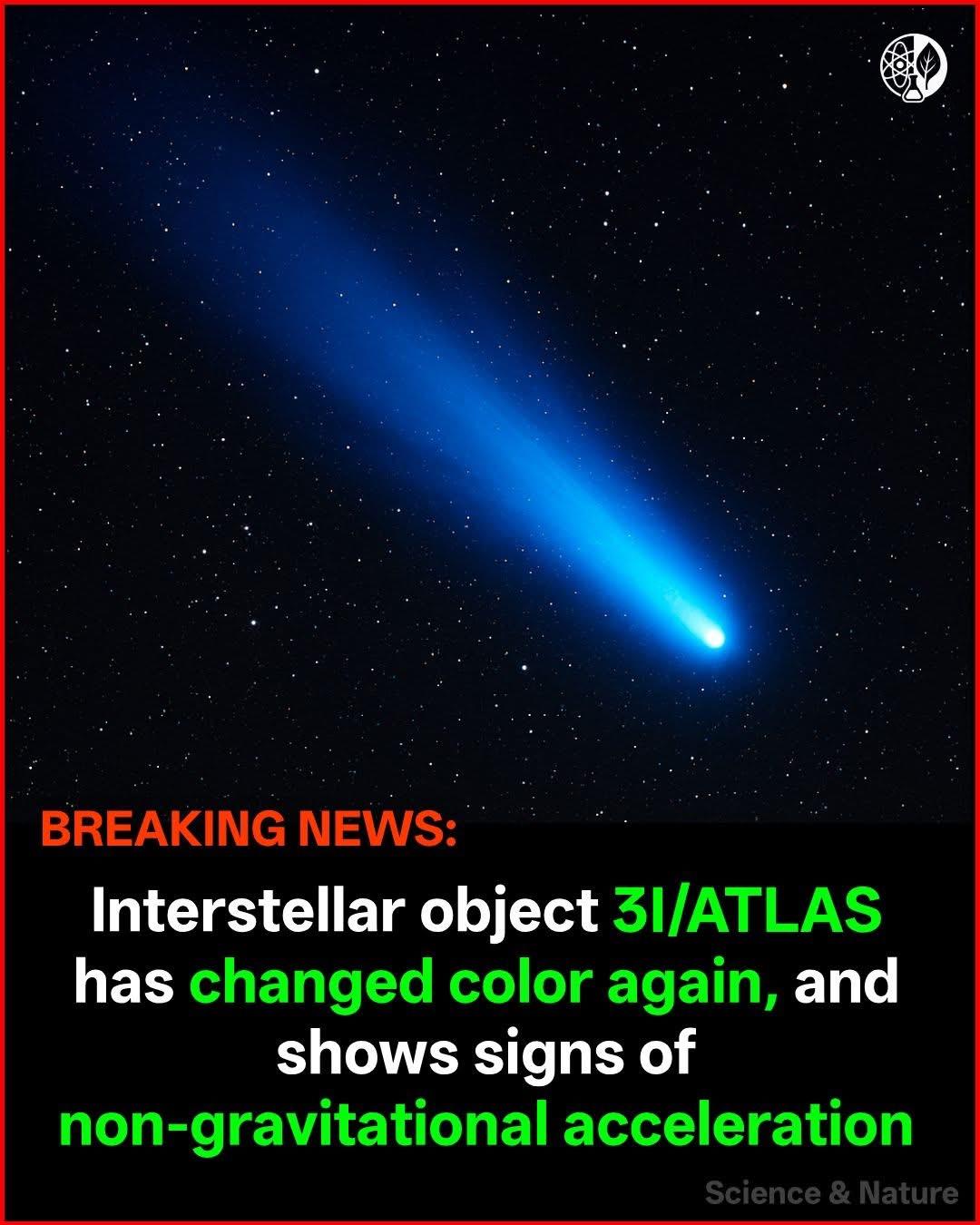
The interstellar object 3I/ATLAS—only the third ever detected passing through our Solar System—has surprised astronomers again.
Color Shift: As it approached perihelion, 3I/ATLAS changed color, appearing noticeably bluer. This likely reflects evolving chemistry in its coma: ionized gases like CO⁺ and CN fluoresce under solar radiation, while shifting dust‑to‑gas ratios alter its glow.
Non‑Gravitational Acceleration: Careful orbital fits now reveal that its path isn’t dictated by gravity alone. Just like comets in our own system, jets of sublimating ice appear to be giving it a tiny “rocket push,” nudging it off a purely gravitational trajectory.
Why does this matter? Each interstellar object is a time capsule from another star system. By studying its changing colors and subtle accelerations, we’re learning how comets form and evolve in alien environments—and how similar (or different) they are to our own.
Keep watching: at around magnitude 9 near perihelion, 3I/ATLAS is within reach of small telescopes and strong binoculars under dark skies.
Reference: Qicheng Zhang et. al, Rapid Brightening of 3I/ATLAS Ahead of Perihelion, arXiv:2510.25035 (astro-ph), DOI: 10.48550/arXiv.2510.25035
#3IATLAS #InterstellarComet #Astronomy #SpaceScience #Outgassing #CosmicVisitor #scrolllink
Color Shift: As it approached perihelion, 3I/ATLAS changed color, appearing noticeably bluer. This likely reflects evolving chemistry in its coma: ionized gases like CO⁺ and CN fluoresce under solar radiation, while shifting dust‑to‑gas ratios alter its glow.
Non‑Gravitational Acceleration: Careful orbital fits now reveal that its path isn’t dictated by gravity alone. Just like comets in our own system, jets of sublimating ice appear to be giving it a tiny “rocket push,” nudging it off a purely gravitational trajectory.
Why does this matter? Each interstellar object is a time capsule from another star system. By studying its changing colors and subtle accelerations, we’re learning how comets form and evolve in alien environments—and how similar (or different) they are to our own.
Keep watching: at around magnitude 9 near perihelion, 3I/ATLAS is within reach of small telescopes and strong binoculars under dark skies.
Reference: Qicheng Zhang et. al, Rapid Brightening of 3I/ATLAS Ahead of Perihelion, arXiv:2510.25035 (astro-ph), DOI: 10.48550/arXiv.2510.25035
#3IATLAS #InterstellarComet #Astronomy #SpaceScience #Outgassing #CosmicVisitor #scrolllink
The interstellar object 3I/ATLAS—only the third ever detected passing through our Solar System—has surprised astronomers again.
🔹 Color Shift: As it approached perihelion, 3I/ATLAS changed color, appearing noticeably bluer. This likely reflects evolving chemistry in its coma: ionized gases like CO⁺ and CN fluoresce under solar radiation, while shifting dust‑to‑gas ratios alter its glow.
🔹 Non‑Gravitational Acceleration: Careful orbital fits now reveal that its path isn’t dictated by gravity alone. Just like comets in our own system, jets of sublimating ice appear to be giving it a tiny “rocket push,” nudging it off a purely gravitational trajectory.
Why does this matter? Each interstellar object is a time capsule from another star system. By studying its changing colors and subtle accelerations, we’re learning how comets form and evolve in alien environments—and how similar (or different) they are to our own.
🔭 Keep watching: at around magnitude 9 near perihelion, 3I/ATLAS is within reach of small telescopes and strong binoculars under dark skies.
Reference: Qicheng Zhang et. al, Rapid Brightening of 3I/ATLAS Ahead of Perihelion, arXiv:2510.25035 (astro-ph), DOI: 10.48550/arXiv.2510.25035
#3IATLAS #InterstellarComet #Astronomy #SpaceScience #Outgassing #CosmicVisitor #scrolllink





 English
 Arabic
 French
 Portuguese
 Deutsch
 Turkish
 Dutch
Dutch
 Hindi
Hindi
 Italiano
 Russian
 Romaian
 Portuguese (Brazil)
 Greek
Greek