



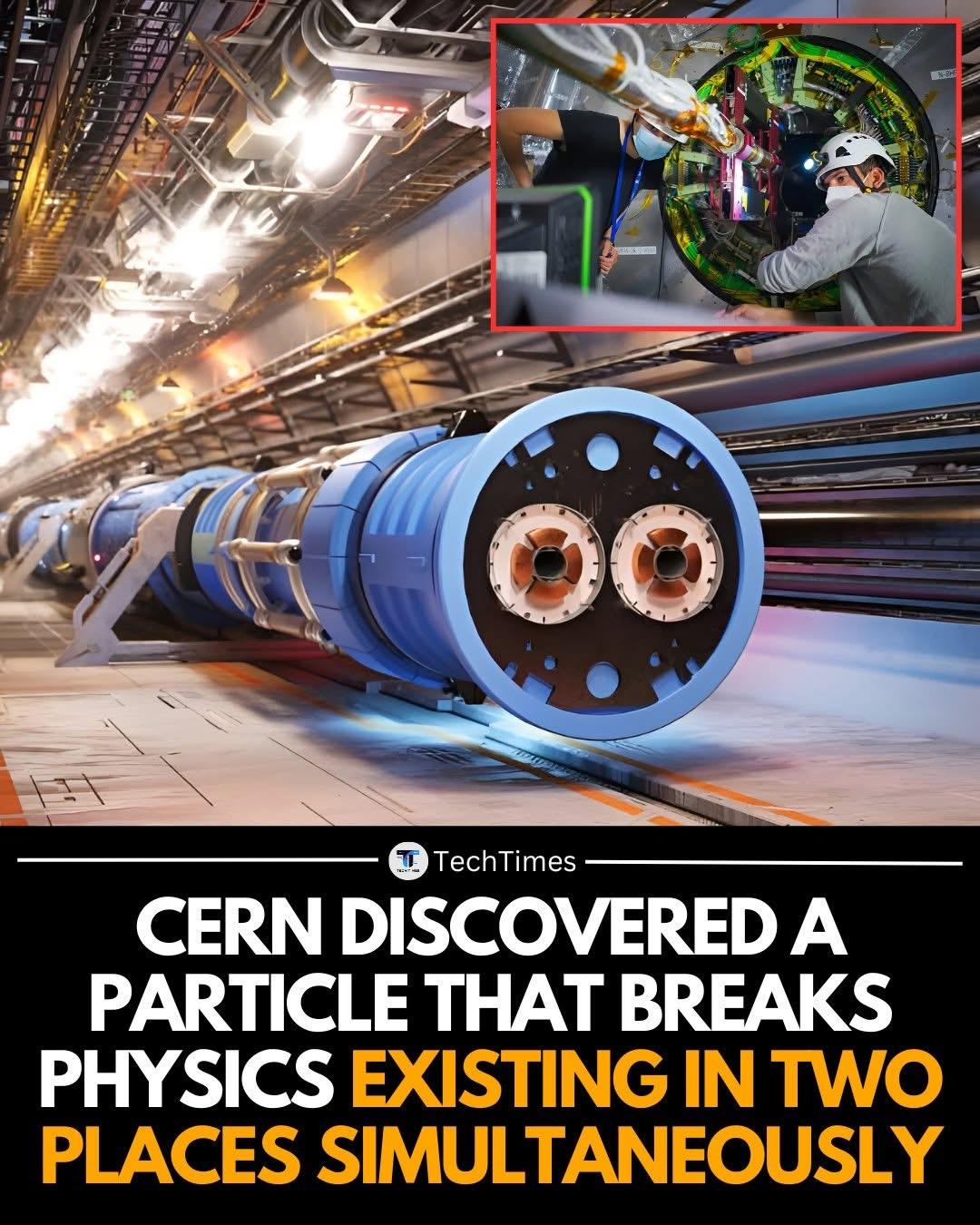
Physicists at CERN’s Large Hadron Collider have observed what may be one of the strangest quantum events ever recorded — a new tetraquark particle that appeared to exist in two separate detector locations simultaneously. The discovery hints at a bridge between quantum mechanics and classical physics, shaking the foundations of modern science.
Unlike protons and neutrons, which are made of three quarks, tetraquarks contain four, forming exotic states of matter rarely seen in nature. During experiments, researchers noticed something unprecedented: the same tetraquark seemed to register 1.4 meters apart at the exact same moment — suggesting quantum superposition on a much larger scale than previously thought possible.
This finding challenges the long-held idea that superposition only applies to microscopic particles. If confirmed, it could revolutionize how we understand space, time, and causality — even paving the way for quantum computers that operate at room temperature and unhackable communication systems based on entangled states.
The particle itself existed for only 10⁻²³ seconds, but in that brief instant, it may have rewritten the rules of reality. CERN’s follow-up experiments aim to verify whether this was a measurement anomaly or the first glimpse of a quantum-classical overlap — a discovery Einstein himself once thought impossible.
#CERN #QuantumPhysics #Tetraquark #Superposition #QuantumMechanics #Scrolllink
Unlike protons and neutrons, which are made of three quarks, tetraquarks contain four, forming exotic states of matter rarely seen in nature. During experiments, researchers noticed something unprecedented: the same tetraquark seemed to register 1.4 meters apart at the exact same moment — suggesting quantum superposition on a much larger scale than previously thought possible.
This finding challenges the long-held idea that superposition only applies to microscopic particles. If confirmed, it could revolutionize how we understand space, time, and causality — even paving the way for quantum computers that operate at room temperature and unhackable communication systems based on entangled states.
The particle itself existed for only 10⁻²³ seconds, but in that brief instant, it may have rewritten the rules of reality. CERN’s follow-up experiments aim to verify whether this was a measurement anomaly or the first glimpse of a quantum-classical overlap — a discovery Einstein himself once thought impossible.
#CERN #QuantumPhysics #Tetraquark #Superposition #QuantumMechanics #Scrolllink
Physicists at CERN’s Large Hadron Collider have observed what may be one of the strangest quantum events ever recorded — a new tetraquark particle that appeared to exist in two separate detector locations simultaneously. The discovery hints at a bridge between quantum mechanics and classical physics, shaking the foundations of modern science.
Unlike protons and neutrons, which are made of three quarks, tetraquarks contain four, forming exotic states of matter rarely seen in nature. During experiments, researchers noticed something unprecedented: the same tetraquark seemed to register 1.4 meters apart at the exact same moment — suggesting quantum superposition on a much larger scale than previously thought possible.
This finding challenges the long-held idea that superposition only applies to microscopic particles. If confirmed, it could revolutionize how we understand space, time, and causality — even paving the way for quantum computers that operate at room temperature and unhackable communication systems based on entangled states.
The particle itself existed for only 10⁻²³ seconds, but in that brief instant, it may have rewritten the rules of reality. CERN’s follow-up experiments aim to verify whether this was a measurement anomaly or the first glimpse of a quantum-classical overlap — a discovery Einstein himself once thought impossible.
#CERN #QuantumPhysics #Tetraquark #Superposition #QuantumMechanics #Scrolllink




 English
 Arabic
 French
 Spanish
 Portuguese
 Deutsch
 Turkish
 Dutch
Dutch
 Hindi
Hindi
 Italiano
 Russian
 Romaian
 Greek
Greek