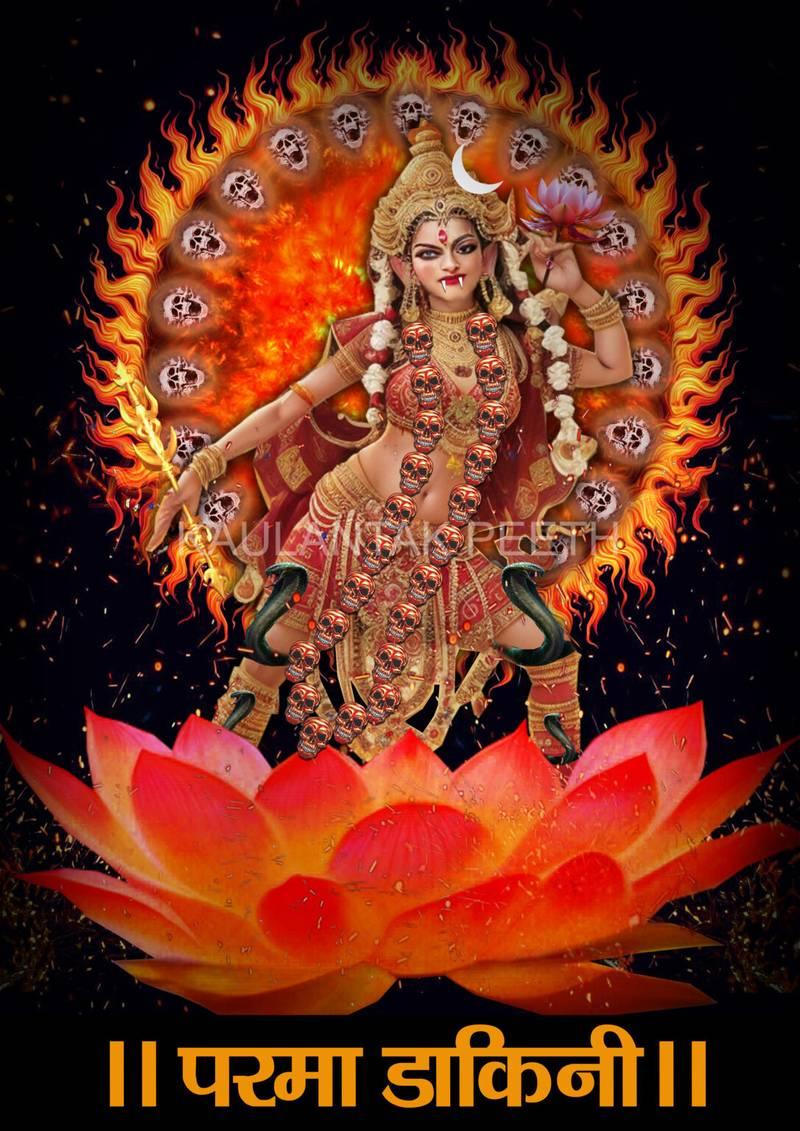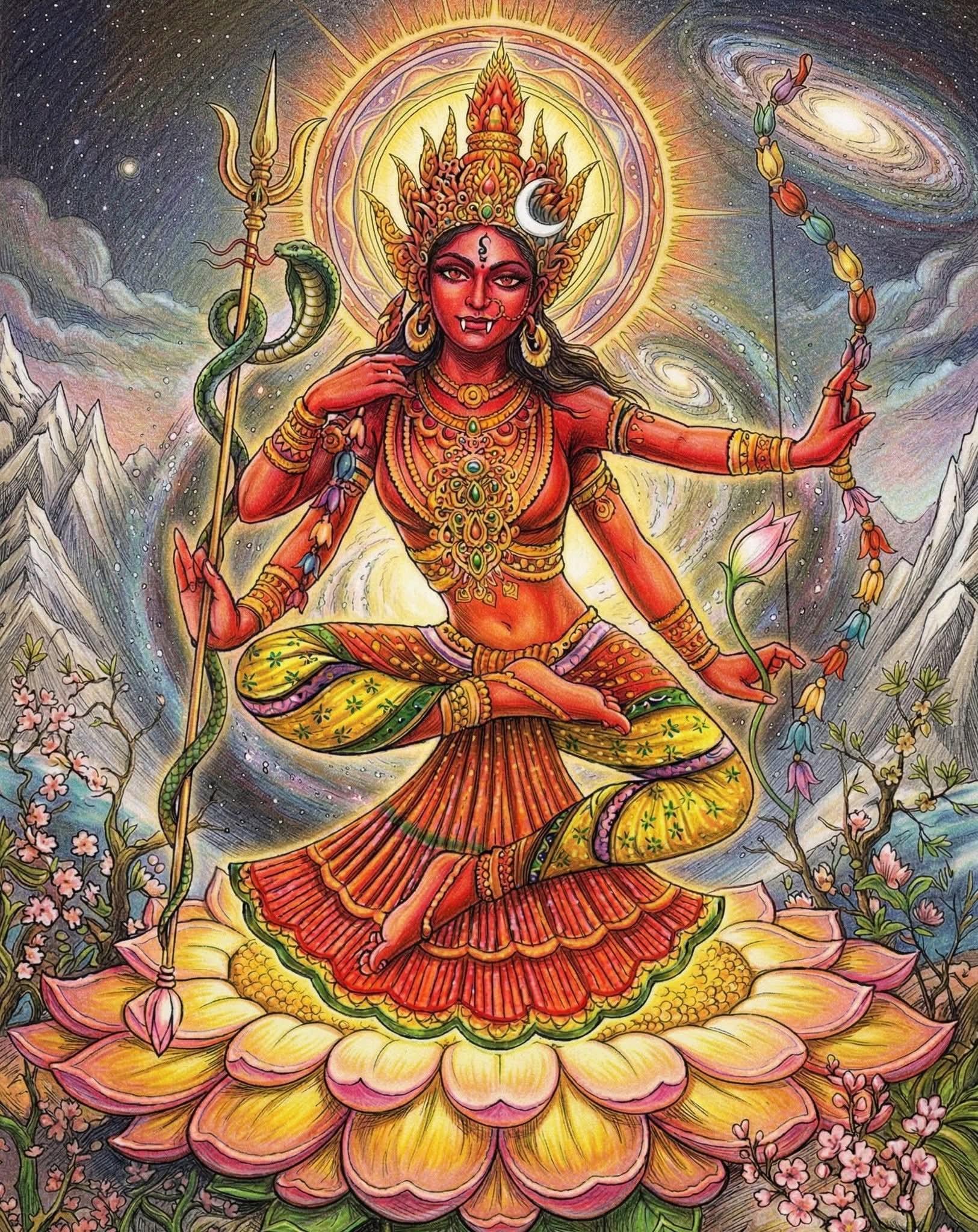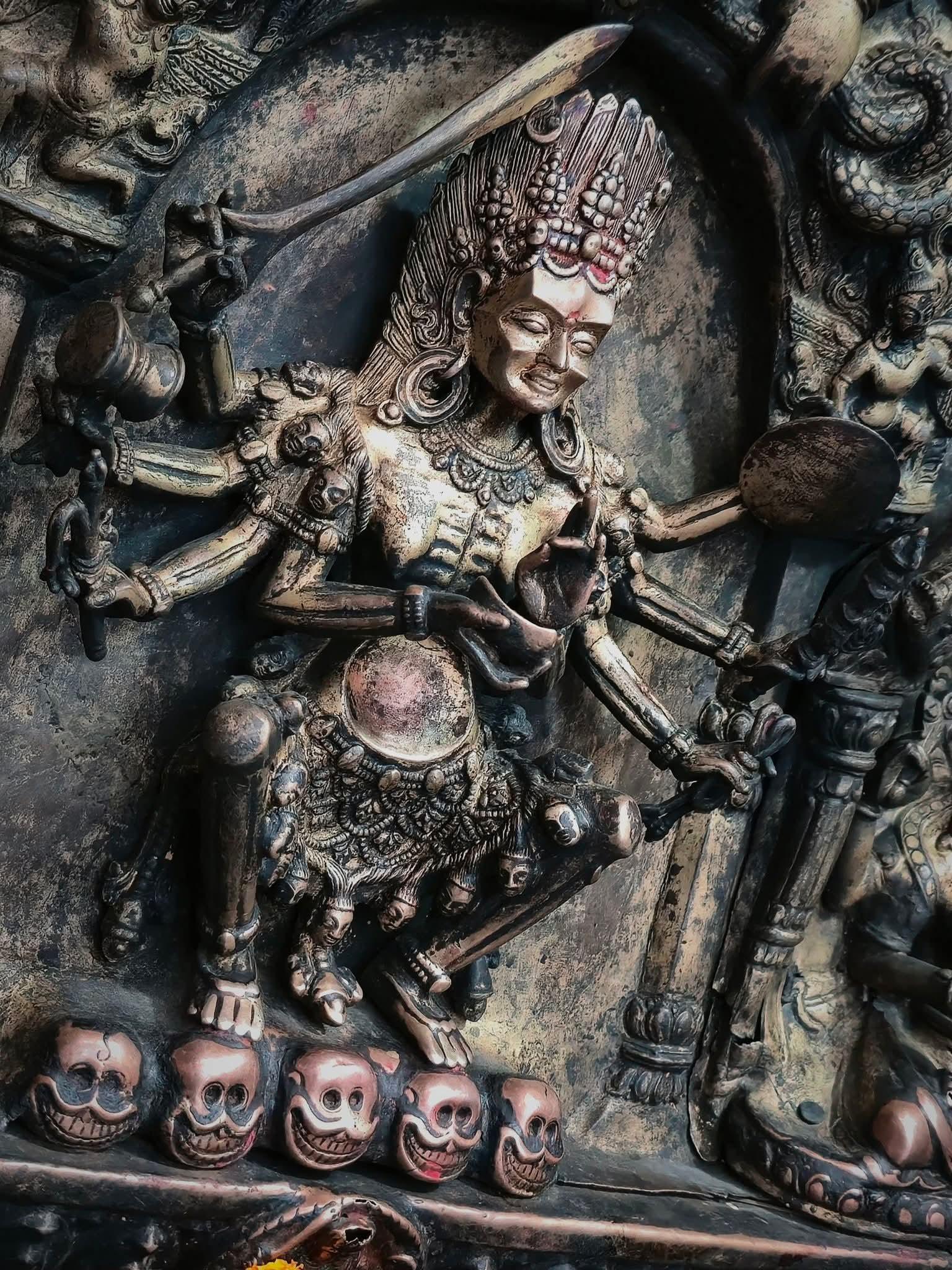



• Matrika Bhairava is regarded as one of the most elevated and secretive manifestations of Shiva within the Tantric tradition. What makes Matrika Bhairava extraordinary is that He contains the full force of every Matrika tradition: the Ashta Matrikas, the Shodasha Matrikas, and the Varna Matrikas. Instead of worshipping these goddesses separately, Tantric teachings reveal that all their energies converge and shine through this single, supreme deity. For that reason, Matrika Bhairava is celebrated as the ultimate source of mantra shakti, the primordial root from which all sacred sounds and mantras arise.

    Within this majestic form reside three of the greatest Shaktis—Brahmi, Mahalakshmi, and Mahagauri. Practitioners pursuing mantra siddhi or wishing to intensify their spiritual evolution often choose Him as their Ishta Devata, because He governs the very vibration, potency, and life-force of all mantras. In Tantric understanding, every mantra’s root energy flows directly from the consciousness of Matrika Bhairava.

    At a deeper and more esoteric level of Tantra, Matrika Bhairava is said to hold within Himself some secret Matrikas represent subtle dimensions of spiritual awakening: inner expansion, divine brilliance, and transformative silence. Only highly advanced practitioners are traditionally introduced to the mysteries of these Matrikas, and it is their presence that elevates Matrika Bhairava to a status higher than most forms of Bhairava. Because He embodies the totality of all Matrika powers, both revealed and hidden, He is considered capable of guiding a seeker toward the highest spiritual goals.

    Tantric scriptures state that sincere worship of Matrika Bhairava has the potential to grant a practitioner liberation, complete mastery over spiritual energies, and ultimately the state of siddhatva—full spiritual accomplishment. His path is not like ordinary worship; it is deeply mystical, inner-oriented, and based on subtle mantra and energy practices. The methods associated with Matrika Bhairava require a level of discipline and dedication suited for those who are genuinely committed to transformative spiritual growth. To know more about the Matrika Bhairav and his sadhana system, here is an article about Matrika bhairava on siddhapedia containing in detail information.

    https://siddhapedia.com/matrika-bhairava

    #matrikabhairava #Matrika #ashtamatrika #bhairav #HimalayanDevaParamapara #SiddhaDharma #Siddhatradition #LordShiva #BhagwanShiv #Mahadev #SwachhandBhairav #kurukulla #Siddhapedia #kaulantakpeeth #kulantpeeth #Ishaputra #MahasiddhaIshaputra #MahayogiSatyendraNath #Meditation #sanatandharma #HimalayanSiddhas #Hindu #Adhyaatma #himalayangod #iksvp #scrolllink
    Matrika Bhairava is regarded as one of the most elevated and secretive manifestations of Shiva within the Tantric tradition. What makes Matrika Bhairava extraordinary is that He contains the full force of every Matrika tradition: the Ashta Matrikas, the Shodasha Matrikas, and the Varna Matrikas. Instead of worshipping these goddesses separately, Tantric teachings reveal that all their energies converge and shine through this single, supreme deity. For that reason, Matrika Bhairava is celebrated as the ultimate source of mantra shakti, the primordial root from which all sacred sounds and mantras arise. Within this majestic form reside three of the greatest Shaktis—Brahmi, Mahalakshmi, and Mahagauri. Practitioners pursuing mantra siddhi or wishing to intensify their spiritual evolution often choose Him as their Ishta Devata, because He governs the very vibration, potency, and life-force of all mantras. In Tantric understanding, every mantra’s root energy flows directly from the consciousness of Matrika Bhairava. At a deeper and more esoteric level of Tantra, Matrika Bhairava is said to hold within Himself some secret Matrikas represent subtle dimensions of spiritual awakening: inner expansion, divine brilliance, and transformative silence. Only highly advanced practitioners are traditionally introduced to the mysteries of these Matrikas, and it is their presence that elevates Matrika Bhairava to a status higher than most forms of Bhairava. Because He embodies the totality of all Matrika powers, both revealed and hidden, He is considered capable of guiding a seeker toward the highest spiritual goals. Tantric scriptures state that sincere worship of Matrika Bhairava has the potential to grant a practitioner liberation, complete mastery over spiritual energies, and ultimately the state of siddhatva—full spiritual accomplishment. His path is not like ordinary worship; it is deeply mystical, inner-oriented, and based on subtle mantra and energy practices. The methods associated with Matrika Bhairava require a level of discipline and dedication suited for those who are genuinely committed to transformative spiritual growth. To know more about the Matrika Bhairav and his sadhana system, here is an article about Matrika bhairava on siddhapedia containing in detail information. https://siddhapedia.com/matrika-bhairava #matrikabhairava #Matrika #ashtamatrika #bhairav #HimalayanDevaParamapara #SiddhaDharma #Siddhatradition #LordShiva #BhagwanShiv #Mahadev #SwachhandBhairav #kurukulla #Siddhapedia #kaulantakpeeth #kulantpeeth #Ishaputra #MahasiddhaIshaputra #MahayogiSatyendraNath #Meditation #sanatandharma #HimalayanSiddhas #Hindu #Adhyaatma #himalayangod #iksvp #scrolllink
    SIDDHAPEDIA.COM
    Matrika Bhairava
    Matrika (Sanskrit- मातृका) is a sanskrit word that symbolizes Motherly Energies whereas Bhairava means The fierce, powerful and fear-destroying form of Shiva. Matrika Bhairava is the form of Swacchanda Bhairava Shiva Himself — who embodies within Him all the Matrikas, such as the Ashta Matrikas, the Shodasha Matrikas, and the Varna Matrikas. He also embodies
    Love
    Like
    9
    0 Reacties 0 aandelen 776 Views 0 voorbeeld
  • Explore the sacred recitation of the 16-names praise of Goddess Kurukullā

    How to use this chant effectively

    Listen with full attention and devotion.

    Repeat the names slowly, perhaps in a calm space.

    Feel the sound vibrations in your body and mind.

    Use this session for grounding, inspiration, or spiritual focus.

    Disclaimer
    As with many tantric mantras, it’s advised to practice with respect, sincerity, and if possible under guidance.

    #Kurukulla#कुरुकुल्ला​ #Mantra#Stuti#DevotionalChant#ॐ#SpiritualPractice#Meditation#Tantra#GoddessEnergy#BuddhistMantra#HinduMantra#DivineFeminine#Chanting#SacredSound​ ‪@ShivashaktiBhaktiGeet‬​
    Explore the sacred recitation of the 16-names praise of Goddess Kurukullā 🔔 How to use this chant effectively Listen with full attention and devotion. Repeat the names slowly, perhaps in a calm space. Feel the sound vibrations in your body and mind. Use this session for grounding, inspiration, or spiritual focus. 🙏 Disclaimer As with many tantric mantras, it’s advised to practice with respect, sincerity, and if possible under guidance. #Kurukulla​ #कुरुकुल्ला​ #Mantra​ #Stuti​ #DevotionalChant​ #ॐ​ #SpiritualPractice​ #Meditation​ #Tantra​ #GoddessEnergy​ #BuddhistMantra​ #HinduMantra​ #DivineFeminine​ #Chanting​ #SacredSound​ ‪@ShivashaktiBhaktiGeet‬​
    Love
    wow
    3
    1 Reacties 0 aandelen 1K Views 7 0 voorbeeld
  • Look, My Fellow Bengalis!
    See what Mamata Banerjee has done to our sacred land of Maa Kali! The land of devotion and courage is now crushed under appeasement and fear.

    When Hindus protest, the police drag Maa Kali’s Murti into prison vans — as if our Goddess is a criminal!
    Is this the Bengal of Vivekananda and Netaji, or a land lost to fanaticism?

    Wake up, Bengal! Protect our Maa, our culture, our Sanatan identity before it’s too late!

    #WestBengal #MaaKali #SaveBengal #SanatanDharma #WakeUpBengal #scrolllink
    Look, My Fellow Bengalis! See what Mamata Banerjee has done to our sacred land of Maa Kali! The land of devotion and courage is now crushed under appeasement and fear. When Hindus protest, the police drag Maa Kali’s Murti into prison vans — as if our Goddess is a criminal! Is this the Bengal of Vivekananda and Netaji, or a land lost to fanaticism? Wake up, Bengal! Protect our Maa, our culture, our Sanatan identity before it’s too late! #WestBengal #MaaKali #SaveBengal #SanatanDharma #WakeUpBengal #scrolllink
    Angry
    1
    0 Reacties 0 aandelen 1K Views 0 voorbeeld
  • Wishing everyone abundant greetings of Diwali from Kaulantak Peeth team. This year, Mahasiddha Ishaputra celebrated Diwali at the sacred Kurukulla Temple. Despite facing immense hardships and challenges, we performed the Diwali puja with utmost devotion at the feet of Bhagwati.

    All roads leading to the Kurukulla Temple were completely blocked, yet Mahasiddha Ishaputra, accompanied by all the Bhairavs and Bhairavis, walked on foot with unwavering determination and reached the temple. There, we lit many lamps (deep), illuminating the entire premises of Bhagwati with radiant light, making it sparkle gloriously.

    Following this, we conducted the grand puja and aarti of Bhagwati amidst great fervor, joy, and celebration. In this way, even in the face of tough circumstances, we ensured that Bhagwati's temple did not remain desolate. Instead, we celebrated Diwali right at Her divine feet, filling the space with devotion, light, and triumph over adversity.

    #Diwali #HappyDiwali #Ishaputra #mahasiddhaishaputra #MahayogiSatyendraNath #kurukulla #goddesskurukulla #lakshmi #KaulantakPeeth #KulantPeeth #IKSVP #bhagwanshiv #shiva #lordshiva #swachchhandbhairava #SiddhaDharma #himalayansiddhatradition #hiddendeities #scrolllink
    Wishing everyone abundant greetings of Diwali from Kaulantak Peeth team. This year, Mahasiddha Ishaputra celebrated Diwali at the sacred Kurukulla Temple. Despite facing immense hardships and challenges, we performed the Diwali puja with utmost devotion at the feet of Bhagwati. All roads leading to the Kurukulla Temple were completely blocked, yet Mahasiddha Ishaputra, accompanied by all the Bhairavs and Bhairavis, walked on foot with unwavering determination and reached the temple. There, we lit many lamps (deep), illuminating the entire premises of Bhagwati with radiant light, making it sparkle gloriously. Following this, we conducted the grand puja and aarti of Bhagwati amidst great fervor, joy, and celebration. In this way, even in the face of tough circumstances, we ensured that Bhagwati's temple did not remain desolate. Instead, we celebrated Diwali right at Her divine feet, filling the space with devotion, light, and triumph over adversity. #Diwali #HappyDiwali #Ishaputra #mahasiddhaishaputra #MahayogiSatyendraNath #kurukulla #goddesskurukulla #lakshmi #KaulantakPeeth #KulantPeeth #IKSVP #bhagwanshiv #shiva #lordshiva #swachchhandbhairava #SiddhaDharma #himalayansiddhatradition #hiddendeities #scrolllink
    Love
    Like
    Yay
    wow
    8
    1 Reacties 1 aandelen 3K Views 0 voorbeeld
  • This Diwali, let us burst a few lesser crackers, eat a little less sweets, use a little less material in our worship, and offer whatever money we save to the reconstruction and service of Bhagwati Kurukulla’s temple.
    This temple belongs to all of us Bhairavs and Bhairavis — Bhagwati Kurukulla and this sacred tradition are ours.
    So, let us all come together and contribute our share for the reconstruction of Her temple.
    Click on the link below and make your offering.

    https://goddesskurukulla.com/donations/

    #SaveKurukullaTemple #Himalaya #Siddhas #MurukullaMandir #tradition
    This Diwali, let us burst a few lesser crackers, eat a little less sweets, use a little less material in our worship, and offer whatever money we save to the reconstruction and service of Bhagwati Kurukulla’s temple. This temple belongs to all of us Bhairavs and Bhairavis — Bhagwati Kurukulla and this sacred tradition are ours. So, let us all come together and contribute our share for the reconstruction of Her temple. Click on the link below and make your offering. https://goddesskurukulla.com/donations/ #SaveKurukullaTemple #Himalaya #Siddhas #MurukullaMandir #tradition
    Love
    Like
    wow
    Sad
    9
    0 Reacties 2 aandelen 2K Views 0 voorbeeld
  • When Bhagwan Ram returned to Ayodhya after his exile, the first thing He did was to worshipping Lord Ganesh and Goddess Laxmi. Since then the tradition started to worship Laxmi and Ganesh on Diwali. It evolved into a religious custom to worship Laxmi and Ganesh on Diwali night as “Diwali Puja”.
    In later days, worshipping Ganesh (Vighnaharta) before any celebration started and by that time - all the earlier glorious battles were almost forgotten and Men started to worship Money aka Lakshmi.
    Diwali is celebrated for different reasons by different people.
    For most strict Vaishnavas, it is the day Rama returned to Ayodhya. Some also celebrate this as the day of liberation of the women captured by Narakasura, after he was killed by Devi Satyabhama (the wife of Lord Krishna)
    For the business community it is the beginning of new year and for the closure of accounts of the previous year and for beginning of the new account books.
    Lakshmi is the goddess of wealth. Hence the Gods of prosperity (that is Devi Lakshmi) and good luck (that is Lord Ganesha) are worshipped.
    For some, Diwali also celebrates the return of Pandavas after 12 years of Vanvas and one year of "Agyatvas" in Mahabharata.
    Once my father said Diwali is the day when Vishnu came back to Lakshmi and their abode in the Vaikuntha; so those who worship Lakshmi receive the benefit of her good mood, and therefore are blessed with mental, physical and material wellbeing during the year ahead.
    Hindus in India's eastern region, such as Odisha and West Bengal, worship the goddess Kali instead of Lakshmi, and call the festival Kali Puja.
    In Braj Bhumi and north central regions, the god Krishna is recognized. People mark Mount Govardhan, and celebrate legends about Krishna. In other regions, the feast of Govardhan Puja (or Annakoot) is celebrated, with 56 or 108 different cuisines prepared, offered to Krishna, then shared and celebrated by the local community.
    Because people in general In in this era of Kalyug are easily trapoed by Maya (illusion) they know only desire, money and sense gratification. They dont know that Where Lord Vishnu resides Laxmi is always present their and serves Him.
    Narakasur was killed by Shri Krishna during Kartik Chaturdashi. Narakasur was the son of Varaha Avatar and Dharitri/Bhudevi ( Mother earth). He got the boon from Brahma that only his mother can kill him. With so much of power, he did all tamasik activity, made friendship with another demon named Mura. He kidnapped 16000+ princes and imprisoned them. He even stole the jewellery of Aditi ( Indra’s mother).
    He crossed all the limits and finally in Dwapar Yug Krishna took birth, attacked Narakasur at night along with Satyabhama and killed his general come friend Mura. Then finally Narakasur. He realized that God Himself came to kill him hence he is getting relieved from all the sins he has done so far. So this death of him should be celebrated. Hence, after Narak Chaturdashi, we celebrate Deepawali – the death of Narakasur.
    The event is celebrated to signify the victory of light over darkness, good against evil, knowledge against ignorance and righteousness over anarchy.

    #दीपावली #diwali #scrolllink #hindu #sanatan #lakshmi
    When Bhagwan Ram returned to Ayodhya after his exile, the first thing He did was to worshipping Lord Ganesh and Goddess Laxmi. Since then the tradition started to worship Laxmi and Ganesh on Diwali. It evolved into a religious custom to worship Laxmi and Ganesh on Diwali night as “Diwali Puja”. In later days, worshipping Ganesh (Vighnaharta) before any celebration started and by that time - all the earlier glorious battles were almost forgotten and Men started to worship Money aka Lakshmi. Diwali is celebrated for different reasons by different people. 🪔For most strict Vaishnavas, it is the day Rama returned to Ayodhya. Some also celebrate this as the day of liberation of the women captured by Narakasura, after he was killed by Devi Satyabhama (the wife of Lord Krishna) 🪔For the business community it is the beginning of new year and for the closure of accounts of the previous year and for beginning of the new account books. 🪔Lakshmi is the goddess of wealth. Hence the Gods of prosperity (that is Devi Lakshmi) and good luck (that is Lord Ganesha) are worshipped. 🪔For some, Diwali also celebrates the return of Pandavas after 12 years of Vanvas and one year of "Agyatvas" in Mahabharata. 🪔Once my father said Diwali is the day when Vishnu came back to Lakshmi and their abode in the Vaikuntha; so those who worship Lakshmi receive the benefit of her good mood, and therefore are blessed with mental, physical and material wellbeing during the year ahead. 🪔Hindus in India's eastern region, such as Odisha and West Bengal, worship the goddess Kali instead of Lakshmi, and call the festival Kali Puja. 🪔In Braj Bhumi and north central regions, the god Krishna is recognized. People mark Mount Govardhan, and celebrate legends about Krishna. In other regions, the feast of Govardhan Puja (or Annakoot) is celebrated, with 56 or 108 different cuisines prepared, offered to Krishna, then shared and celebrated by the local community. Because people in general In in this era of Kalyug are easily trapoed by Maya (illusion) they know only desire, money and sense gratification. They dont know that Where Lord Vishnu resides Laxmi is always present their and serves Him. Narakasur was killed by Shri Krishna during Kartik Chaturdashi. Narakasur was the son of Varaha Avatar and Dharitri/Bhudevi ( Mother earth). He got the boon from Brahma that only his mother can kill him. With so much of power, he did all tamasik activity, made friendship with another demon named Mura. He kidnapped 16000+ princes and imprisoned them. He even stole the jewellery of Aditi ( Indra’s mother). He crossed all the limits and finally in Dwapar Yug Krishna took birth, attacked Narakasur at night along with Satyabhama and killed his general come friend Mura. Then finally Narakasur. He realized that God Himself came to kill him hence he is getting relieved from all the sins he has done so far. So this death of him should be celebrated. Hence, after Narak Chaturdashi, we celebrate Deepawali – the death of Narakasur. The event is celebrated to signify the victory of light over darkness, good against evil, knowledge against ignorance and righteousness over anarchy. #दीपावली #diwali #scrolllink #hindu #sanatan #lakshmi
    Love
    Like
    6
    0 Reacties 1 aandelen 2K Views 0 voorbeeld
  • https://donations.goddesskurukulla.com/
    https://donations.goddesskurukulla.com/
    Like
    Love
    2
    0 Reacties 0 aandelen 722 Views 0 voorbeeld
  • Namo Bhagwati Kurukulle

    #kurukulla #Bhagwati #Goddesskurukulla #maya #scrolllink
    Namo Bhagwati Kurukulle 🙏🙏🙏 #kurukulla #Bhagwati #Goddesskurukulla #maya #scrolllink
    Love
    Like
    3
    0 Reacties 0 aandelen 1K Views 0 voorbeeld
  • International Kaulantak Siddha Vidya Peeth (IKSVP) presents the sacred glimpses of the recent course on Devabhisheka, an important part of Dev Sadhana in the Himalayan Siddha tradition. This sacred two-day ritual, conducted by IKSVP, was a profound spiritual event for all Bhairavs and Bhairavis.
    Day 1 began with Kaulantak Peethadishwar Ishaputra gracing the gathering, addressing and explaining the meaning and significance of Devabhisheka. A grand Saptsindhu chakra was crafted in the soil, followed by a yagya, invoking divine energies.
    Day 2 saw a serene atmosphere with everyone dressed in white. The Devabhisheka was bestowed by Kaulantak Peethadishwar upon the Bhairavs and Bhairavis, who carried a symbolic sword as an astra. The sacred waters, part of the Tirthan river, were icy cold, yet people’s spirits remained high, and everyone participated with devotion. By dusk, another powerful yagya took place, concluding with the pooja of 64 yoginis, marking the completion of this divine event.
    We are sharing with you these glimpses, so you can witness the energy of this sacred ceremony. If you wish to experience the spiritual depth of such traditions, you are welcome to join the regular courses offered by IKSVP, both online and offline.
    Om Shri Kulant Nathaay Namah.
    Om Shri Kulant Peethaay Namah.
    Om Sam Siddhaay Namah.
    Om Shri Gurumandalaay Namah.
    Om Shri MahaHimalayaay NAmah.
    Om Shri Swachchanda Bhairavaay Namah.
    Om Shri Kulle Kurukulle Namah.

    #Devabhisheka #Siddhas #abhisheka #ishaputra #MahasiddhaIshaputra #Kulantpeeth #Kurukulla #kurukullaTemple #IKSVP #DevaDharma #DeshajParampara #Healing #IKSVP #Spirituality #AncientWisdom #GoddessKurukulla #Saptrishis #Mysticism #KaulantakPeeth #Ishaputra #DivineBlessings #Mahasiddha #KaulantakSiddhaVidyaPeeth
    International Kaulantak Siddha Vidya Peeth (IKSVP) presents the sacred glimpses of the recent course on Devabhisheka, an important part of Dev Sadhana in the Himalayan Siddha tradition. This sacred two-day ritual, conducted by IKSVP, was a profound spiritual event for all Bhairavs and Bhairavis. Day 1 began with Kaulantak Peethadishwar Ishaputra gracing the gathering, addressing and explaining the meaning and significance of Devabhisheka. A grand Saptsindhu chakra was crafted in the soil, followed by a yagya, invoking divine energies. Day 2 saw a serene atmosphere with everyone dressed in white. The Devabhisheka was bestowed by Kaulantak Peethadishwar upon the Bhairavs and Bhairavis, who carried a symbolic sword as an astra. The sacred waters, part of the Tirthan river, were icy cold, yet people’s spirits remained high, and everyone participated with devotion. By dusk, another powerful yagya took place, concluding with the pooja of 64 yoginis, marking the completion of this divine event. We are sharing with you these glimpses, so you can witness the energy of this sacred ceremony. If you wish to experience the spiritual depth of such traditions, you are welcome to join the regular courses offered by IKSVP, both online and offline. Om Shri Kulant Nathaay Namah. Om Shri Kulant Peethaay Namah. Om Sam Siddhaay Namah. Om Shri Gurumandalaay Namah. Om Shri MahaHimalayaay NAmah. Om Shri Swachchanda Bhairavaay Namah. Om Shri Kulle Kurukulle Namah. #Devabhisheka #Siddhas #abhisheka #ishaputra #MahasiddhaIshaputra #Kulantpeeth #Kurukulla #kurukullaTemple #IKSVP #DevaDharma #DeshajParampara #Healing #IKSVP #Spirituality #AncientWisdom #GoddessKurukulla #Saptrishis #Mysticism #KaulantakPeeth #Ishaputra #DivineBlessings #Mahasiddha #KaulantakSiddhaVidyaPeeth
    Love
    wow
    4
    0 Reacties 0 aandelen 3K Views 0 voorbeeld
  • We are overjoyed to share the sacred experiences from the recent two-day Shri Krishna Initiation Course, organized by the International Kaulantak Siddha Vidya Peeth. This spiritually transformative event was a powerful blend of divine wisdom, deep devotion, and profound inner exploration, guiding each participant on a journey toward spiritual awakening.
    The air was filled with divine vibrations as sacred mantras and shlokas resonated throughout the space, accompanied by soul-stirring bhajans and stotras dedicated to Bhagwan Shri Krishna. The spiritual energy was palpable, enveloping everyone in an atmosphere of peace and devotion. Bhairavas and Bhairavis also had the sacred opportunity to participate in Karmkananda rituals and receive words of wisdom from Mahasiddha Ishaputra himself.
    Part-1:
    - Om Shri Kulant Nathaya Namah
    - Om Sam Siddhaya Namah
    - Om Shri Gurumandalaya Namah
    - Om Shri Swachchanda Bhairvaya Namah
    - Om Shri Kulle Kurukulle Namah
    - Om Shri Kulant Peethaya Namah
    - Om Shri Ishaputray Namah
    - Name Adesh!

    Swipe through the pictures to relive these sacred moments and immerse yourself in the divine energy of Bhagwan Shri Krishna’s grace.
    #ShriKrishna #Siddhas #KrishnaJanmashtami #Healing #IKSVP #SaptrishiCourse #Spirituality #AncientWisdom #GoddessKurukulla #Saptrishis #Mysticism #KaulantakPeeth #Ishaputra #DivineBlessings
    We are overjoyed to share the sacred experiences from the recent two-day Shri Krishna Initiation Course, organized by the International Kaulantak Siddha Vidya Peeth. This spiritually transformative event was a powerful blend of divine wisdom, deep devotion, and profound inner exploration, guiding each participant on a journey toward spiritual awakening. 🙏🕉️ The air was filled with divine vibrations as sacred mantras and shlokas resonated throughout the space, accompanied by soul-stirring bhajans and stotras dedicated to Bhagwan Shri Krishna. The spiritual energy was palpable, enveloping everyone in an atmosphere of peace and devotion. Bhairavas and Bhairavis also had the sacred opportunity to participate in Karmkananda rituals and receive words of wisdom from Mahasiddha Ishaputra himself. 🎶💫 Part-1: - Om Shri Kulant Nathaya Namah - Om Sam Siddhaya Namah - Om Shri Gurumandalaya Namah - Om Shri Swachchanda Bhairvaya Namah - Om Shri Kulle Kurukulle Namah - Om Shri Kulant Peethaya Namah - Om Shri Ishaputray Namah - Name Adesh! Swipe through the pictures to relive these sacred moments and immerse yourself in the divine energy of Bhagwan Shri Krishna’s grace. 🙌✨ #ShriKrishna #Siddhas #KrishnaJanmashtami #Healing #IKSVP #SaptrishiCourse #Spirituality #AncientWisdom #GoddessKurukulla #Saptrishis #Mysticism #KaulantakPeeth #Ishaputra #DivineBlessings
    Love
    wow
    4
    0 Reacties 0 aandelen 2K Views 0 voorbeeld
  • Rani Ki Vav at Patan, Gujarat also known as Queen's Stepwell
    Rani Ki Vav, Patan
    Queen's Stepwell, A UNESCO World Heritage Site

    Patan is a district in the state of Gujarat, located at 125kms distance from Ahmedabad. Patan was once the capital of the state in historic times located on the banks of the (lost) Saraswati River. Nestled in the hustle and bustle of the city Patan, lies an “Architectural Wonder” – Rani Ki Vav. It is also known as “Rani Ni Vav” in Gujarati local dialect. This is a 7 storeyed Magnificent Stepwell, which is built using scientific principles for storing water.

    Back in 11th century, Udaymati, Queen of the King Bhimadev I from Solanki(Chalukya) Dynasty, expressed her desire to build a stepwell. This stepwell, she ordered to build is in the memory of her beloved husband.

    Rani ki Vav is one of the UNESCO World Heritage sites in India.
    The new ₹100 rupee currency note has a picture of this stepwell.

    Let’s have a visual tour of Stepwell
    As you walk towards this site, it doesn’t appeal very much. Just a compound wall and some—Well Kept—landscaping work is done around it. The more you approach it, the more it starts appealing. When you reach the main entrance, the Jaw-Dropping view absorbs you in it. Perspective steps going deep down towards the well-shaft are accompanied by intricately carved idols of gods and goddesses. Each idol is as magnificent as if they are living things. The far end is of this stepwell—which is a well-shaft—is not even clearly visible from the first step.

    Constructional Aspects

    Rani ki Vav was constructed as a religious as well as a functional structure. The expanse of this stepwell is roughly 1610 sq.m. and 70m length from the base of Toran—Sacred Gateway—to the inner edge of well-shaft. Its 23m in width and 28m in depth. Rani Ki Vav is constructed like an inverted temple highlighting the sanctity of water. It is built on the East-West axis, “Step-Corridor” being in the east and “Well” on the west.

    Ceremonial Entrance (Toran Dwaar)
    The first architectural object you see as you step down, is the remains of a pillar base. This evidently confirms the presence of Toran Dwaar – A Ceremonial Entrance. In 19th century, a survey was conducted for Rani Ki Vav. James Burgess and Henry Cousens were two archeologists who had mentioned about these pillars in the survey.

    The Toran was comprised of 2 freely standing pillars, which were connected by an ornate arch at their upper sections. Towards the west side from this entrance, downward leading steps make a way to the edge of the well.

    Ceremonial Entrance (Toran Dwaar)Ceremonial Entrance (Toran Dwaar)
    Architecture and Decorative Work
    Rani ki vav is a seven storeyed and inverted temple like structure. It has 4 pavilions downwards from east to west and then lastly a Well Shaft. Below is a picture taken from first pavellion. You can see other 3 Pavilions as well. Rani ki Vav is a Maru-Gurjara style architecture. A style of “temple architecure” which is originated from the Gujarat & Rajasthan in historic times.

    All the 7 levels were open for public and tourists were able to go down to the well. Then there was a powerful earthquake in Bhuj which rocked the state of Gujarat in 2001. After this earchquake, out of 7 levels, only 4 levels are left open for public to ensure the safety & security.

    There is a great diversity of themes:
    Divine Figures: Devi or Goddess, Brahma, Vishnu, Shiva, Ganesha in their respective incarnations and form

    Sacred & Mythical Representation Figures: Dikpalas, Sacred flora and fauna, Apsara, Nagkanya, Vasus and scenes from epics
    Reflection of Contemporary Society
    Buddha, Kalki and Mahishasurmardini sculptureFrom left Buddha, Kalki and Mahishasurmardini Sculpture
    Mahishasurmardini is one of the forms of a goddess “Durga” who is killing a demon called Mahishasur.

    MahishasurmardiniMahishasurmardini
    Sculptures in Rani ki Vav are displayed in a pattern, where main deities are displayed in niches. These main deities are flanked by semi divine figures like Apsaras, Nagkanya, Dikpalas and Yogini.&
    Sheshshayi Vishnu Sculpture

    During medieval times in Gujarat, there was a tradition of installing “A Sheshshayi Vishnu” sculpture inside the Stepwell, Kunda or Temples. Which you can see in Modhera Sun Temple as well. Sheshshayi Vishnu is represented in 3 successive niches in 3 levels on the rear wall of the Well Shaft. One between the first and second pavillion on the niche of the north wall.

    In addition to this, out of 24 forms of the lord Vishnu, following forms are present in Rani ki Vav:

    Keshava, Narayana, Govinda, Vishnu, Trivikrama, Vamana, Sridhara, Padmanabha, Damodar, Samkarsana, Aniruddha, Purusottama, Narsimha, Hari. Moreover 10 famous incarnations are also represented. But among those 10 incarnations; Varah, Narsimha, Vaman, Parshuram, Ram, Balram, Buddha and Kalki (future incarnation at the end of Kaliyug) are clearly identified in Rani ki Vav. Buddha is shown as an incarnation of the lord Vishnu here.

    A Bhairav—fierce form of the lord Shiv—is represented in a dancing pose here. If you take a closer look down on his right side, the dog is snatching a piece from the decapitated corpse. Licking the blood oozing from the freshly cut head that Bhairava is holding in his hand.

    Vishnu On Left and Bhairav on rightVishnu On the Left and Bhairav on the Right
    Brahma, Mahesh & Vishnu With Their Consort
    When you reach near the well (at 4th pavillion) you can see the panel of “Brahma, Mahesh & Vishnu with Their Consort”. The Top left side of front wall is decorated with the idols of Tridev(Ttriple deity of Supreme Divinity in Hinduism). Their Vahan is also present near each of them, Swan, Bull and Garuda respectively.

    Front wall sculptures from bottom levelFront wall sculptures at base level
    Brahma Mahesh and Vishnu with their consortsBrahma Mahesh & Vishnu With Their Consort

    On the Top-Right side of the front wall, you can see Ganesh with his Consort and then Maha-Lakshmi and Kuber idols are also present. These three are considered as Gods of Luck.

    Other Sculptures in Rani ki Vav

    Dikpals (Guardians of Eight Directions) also appear on the walls of Rani ki Vav.

    8 Vasus are present on the walls with human body and Cow head in folded hands (Namaskar position).

    Nav graha are represented in a complete set, over Sheshshayi Vishnu on the Well Shaft. Sun (Surya), Moon (Chandra), Mercury (Budha also known as Grahpati), Venus (Shukra), Mars (Mangal), Jupiter (Brihaspati), Saturn (Shani), Rahu and Ketu constitute Nine Planets called Nav Graha.
    Dikpal - Guardian of directionDikpal – Guardian of A Direction

    A Marble sculpture of 48cm height was recovered while de-silting in 1987-88. This sculpture has an inscription in devnagari(indian script) “Maharajani Shri Udayamati”. Due to time constraints, we did not get a chance to see this sculpture. Hence, have no idea where it is kept (May be in museum).

    Rani Ki Vav is built using burnt bricks, lime mortar, and locally available “Dhrangadhra” stone. Larger blocks of stones were joined by Rosewood Dowels and placed on the ground, forming the floor of the steps and terraces.

    Interlocking system with woodInterlocking System With Wood

    A small glass plate was attached at several places where cracks are visible. These cracks were developed after Bhuj’s Earthquake. Upon asking about the purpose of these glass plates, our guide told us they are attached to keep the track of changes in such sections. When the stress on such sections will be increased, these glass plates will break and give an indication for safety.

    #thehinduheritage #CulturalHeritage
    #thehindugodsandgoddesses #scrolllink #bharat
    Rani Ki Vav at Patan, Gujarat also known as Queen's Stepwell Rani Ki Vav, Patan Queen's Stepwell, A UNESCO World Heritage Site Patan is a district in the state of Gujarat, located at 125kms distance from Ahmedabad. Patan was once the capital of the state in historic times located on the banks of the (lost) Saraswati River. Nestled in the hustle and bustle of the city Patan, lies an “Architectural Wonder” – Rani Ki Vav. It is also known as “Rani Ni Vav” in Gujarati local dialect. This is a 7 storeyed Magnificent Stepwell, which is built using scientific principles for storing water. Back in 11th century, Udaymati, Queen of the King Bhimadev I from Solanki(Chalukya) Dynasty, expressed her desire to build a stepwell. This stepwell, she ordered to build is in the memory of her beloved husband. Rani ki Vav is one of the UNESCO World Heritage sites in India. The new ₹100 rupee currency note has a picture of this stepwell. Let’s have a visual tour of Stepwell As you walk towards this site, it doesn’t appeal very much. Just a compound wall and some—Well Kept—landscaping work is done around it. The more you approach it, the more it starts appealing. When you reach the main entrance, the Jaw-Dropping view absorbs you in it. Perspective steps going deep down towards the well-shaft are accompanied by intricately carved idols of gods and goddesses. Each idol is as magnificent as if they are living things. The far end is of this stepwell—which is a well-shaft—is not even clearly visible from the first step. Constructional Aspects Rani ki Vav was constructed as a religious as well as a functional structure. The expanse of this stepwell is roughly 1610 sq.m. and 70m length from the base of Toran—Sacred Gateway—to the inner edge of well-shaft. Its 23m in width and 28m in depth. Rani Ki Vav is constructed like an inverted temple highlighting the sanctity of water. It is built on the East-West axis, “Step-Corridor” being in the east and “Well” on the west. Ceremonial Entrance (Toran Dwaar) The first architectural object you see as you step down, is the remains of a pillar base. This evidently confirms the presence of Toran Dwaar – A Ceremonial Entrance. In 19th century, a survey was conducted for Rani Ki Vav. James Burgess and Henry Cousens were two archeologists who had mentioned about these pillars in the survey. The Toran was comprised of 2 freely standing pillars, which were connected by an ornate arch at their upper sections. Towards the west side from this entrance, downward leading steps make a way to the edge of the well. Ceremonial Entrance (Toran Dwaar)Ceremonial Entrance (Toran Dwaar) Architecture and Decorative Work Rani ki vav is a seven storeyed and inverted temple like structure. It has 4 pavilions downwards from east to west and then lastly a Well Shaft. Below is a picture taken from first pavellion. You can see other 3 Pavilions as well. Rani ki Vav is a Maru-Gurjara style architecture. A style of “temple architecure” which is originated from the Gujarat & Rajasthan in historic times. All the 7 levels were open for public and tourists were able to go down to the well. Then there was a powerful earthquake in Bhuj which rocked the state of Gujarat in 2001. After this earchquake, out of 7 levels, only 4 levels are left open for public to ensure the safety & security. There is a great diversity of themes: Divine Figures: Devi or Goddess, Brahma, Vishnu, Shiva, Ganesha in their respective incarnations and form Sacred & Mythical Representation Figures: Dikpalas, Sacred flora and fauna, Apsara, Nagkanya, Vasus and scenes from epics Reflection of Contemporary Society Buddha, Kalki and Mahishasurmardini sculptureFrom left Buddha, Kalki and Mahishasurmardini Sculpture Mahishasurmardini is one of the forms of a goddess “Durga” who is killing a demon called Mahishasur. MahishasurmardiniMahishasurmardini Sculptures in Rani ki Vav are displayed in a pattern, where main deities are displayed in niches. These main deities are flanked by semi divine figures like Apsaras, Nagkanya, Dikpalas and Yogini.& Sheshshayi Vishnu Sculpture During medieval times in Gujarat, there was a tradition of installing “A Sheshshayi Vishnu” sculpture inside the Stepwell, Kunda or Temples. Which you can see in Modhera Sun Temple as well. Sheshshayi Vishnu is represented in 3 successive niches in 3 levels on the rear wall of the Well Shaft. One between the first and second pavillion on the niche of the north wall. In addition to this, out of 24 forms of the lord Vishnu, following forms are present in Rani ki Vav: Keshava, Narayana, Govinda, Vishnu, Trivikrama, Vamana, Sridhara, Padmanabha, Damodar, Samkarsana, Aniruddha, Purusottama, Narsimha, Hari. Moreover 10 famous incarnations are also represented. But among those 10 incarnations; Varah, Narsimha, Vaman, Parshuram, Ram, Balram, Buddha and Kalki (future incarnation at the end of Kaliyug) are clearly identified in Rani ki Vav. Buddha is shown as an incarnation of the lord Vishnu here. A Bhairav—fierce form of the lord Shiv—is represented in a dancing pose here. If you take a closer look down on his right side, the dog is snatching a piece from the decapitated corpse. Licking the blood oozing from the freshly cut head that Bhairava is holding in his hand. Vishnu On Left and Bhairav on rightVishnu On the Left and Bhairav on the Right Brahma, Mahesh & Vishnu With Their Consort When you reach near the well (at 4th pavillion) you can see the panel of “Brahma, Mahesh & Vishnu with Their Consort”. The Top left side of front wall is decorated with the idols of Tridev(Ttriple deity of Supreme Divinity in Hinduism). Their Vahan is also present near each of them, Swan, Bull and Garuda respectively. Front wall sculptures from bottom levelFront wall sculptures at base level Brahma Mahesh and Vishnu with their consortsBrahma Mahesh & Vishnu With Their Consort On the Top-Right side of the front wall, you can see Ganesh with his Consort and then Maha-Lakshmi and Kuber idols are also present. These three are considered as Gods of Luck. Other Sculptures in Rani ki Vav Dikpals (Guardians of Eight Directions) also appear on the walls of Rani ki Vav. 8 Vasus are present on the walls with human body and Cow head in folded hands (Namaskar position). Nav graha are represented in a complete set, over Sheshshayi Vishnu on the Well Shaft. Sun (Surya), Moon (Chandra), Mercury (Budha also known as Grahpati), Venus (Shukra), Mars (Mangal), Jupiter (Brihaspati), Saturn (Shani), Rahu and Ketu constitute Nine Planets called Nav Graha. Dikpal - Guardian of directionDikpal – Guardian of A Direction A Marble sculpture of 48cm height was recovered while de-silting in 1987-88. This sculpture has an inscription in devnagari(indian script) “Maharajani Shri Udayamati”. Due to time constraints, we did not get a chance to see this sculpture. Hence, have no idea where it is kept (May be in museum). Rani Ki Vav is built using burnt bricks, lime mortar, and locally available “Dhrangadhra” stone. Larger blocks of stones were joined by Rosewood Dowels and placed on the ground, forming the floor of the steps and terraces. Interlocking system with woodInterlocking System With Wood A small glass plate was attached at several places where cracks are visible. These cracks were developed after Bhuj’s Earthquake. Upon asking about the purpose of these glass plates, our guide told us they are attached to keep the track of changes in such sections. When the stress on such sections will be increased, these glass plates will break and give an indication for safety. #thehinduheritage #CulturalHeritage #thehindugodsandgoddesses #scrolllink #bharat
    Like
    Love
    5
    0 Reacties 0 aandelen 2K Views 0 voorbeeld
  • Saptarishis Course Day - 1
    We are excited to share that International Kaulantak Siddha Vidyapeeth (IKSVP) has successfully commenced a transformative two-day course on the revered Saptrishi Gurumandal. On the first day, participants delved deep into the ancient and rich yoga traditions of the Saptarishis. Each of the seven rishis possesses a unique yoga lineage, encompassing a variety of practices such as Yoga Asana, Pranayama, and visualization techniques. This immersive experience provided attendees with profound insights into these timeless traditions, allowing them to connect with the wisdom of the Saptarishis.
    The day was filled with enlightening sessions and practical demonstrations that left everyone inspired and rejuvenated. The diverse practices taught not only enriched their understanding of yoga but also offered them practical tools for enhancing their personal spiritual journey. Stay tuned for more updates on the second day of this incredible course!
    (Course Day-1 Part-1)
    Om Shri Kulant Nathaay Namah.
    Om Sam Siddhaay Namah.
    Om Shri Gurumandalaay Namah.
    Om Shri Swachchanda Bhairvaay Namah.
    Om Shri Kulle Kurukulle Namah.
    Om Shri Kulant Peethaay Namah.
    Om Shri Ishaputray Namah.
    Name Adesh!

    #shrikrishna #Siddhas #krishnajanmashtami #Healing #IKSVP #SaptrishiCourse #Spirituality #Mystery #AncientWisdom #GoddessKurukulla #Saptrishis #mystery #mysticism #KaulantakPeeth #Ishaputra
    🌟 Saptarishis Course Day - 1 🌟 We are excited to share that International Kaulantak Siddha Vidyapeeth (IKSVP) has successfully commenced a transformative two-day course on the revered Saptrishi Gurumandal. On the first day, participants delved deep into the ancient and rich yoga traditions of the Saptarishis. Each of the seven rishis possesses a unique yoga lineage, encompassing a variety of practices such as Yoga Asana, Pranayama, and visualization techniques. This immersive experience provided attendees with profound insights into these timeless traditions, allowing them to connect with the wisdom of the Saptarishis. The day was filled with enlightening sessions and practical demonstrations that left everyone inspired and rejuvenated. The diverse practices taught not only enriched their understanding of yoga but also offered them practical tools for enhancing their personal spiritual journey. Stay tuned for more updates on the second day of this incredible course! 🧘‍♂️✨ (Course Day-1 Part-1) Om Shri Kulant Nathaay Namah. Om Sam Siddhaay Namah. Om Shri Gurumandalaay Namah. Om Shri Swachchanda Bhairvaay Namah. Om Shri Kulle Kurukulle Namah. Om Shri Kulant Peethaay Namah. Om Shri Ishaputray Namah. Name Adesh! #shrikrishna #Siddhas #krishnajanmashtami #Healing #IKSVP #SaptrishiCourse #Spirituality #Mystery #AncientWisdom #GoddessKurukulla #Saptrishis #mystery #mysticism #KaulantakPeeth #Ishaputra
    Love
    5
    0 Reacties 0 aandelen 2K Views 0 voorbeeld
Zoekresultaten