Rani Ki Vav at Patan, Gujarat also known as Queen's Stepwell
Rani Ki Vav, Patan
Queen's Stepwell, A UNESCO World Heritage Site
Patan is a district in the state of Gujarat, located at 125kms distance from Ahmedabad. Patan was once the capital of the state in historic times located on the banks of the (lost) Saraswati River. Nestled in the hustle and bustle of the city Patan, lies an “Architectural Wonder” – Rani Ki Vav. It is also known as “Rani Ni Vav” in Gujarati local dialect. This is a 7 storeyed Magnificent Stepwell, which is built using scientific principles for storing water.
Back in 11th century, Udaymati, Queen of the King Bhimadev I from Solanki(Chalukya) Dynasty, expressed her desire to build a stepwell. This stepwell, she ordered to build is in the memory of her beloved husband.
Rani ki Vav is one of the UNESCO World Heritage sites in India.
The new ₹100 rupee currency note has a picture of this stepwell.
Let’s have a visual tour of Stepwell
As you walk towards this site, it doesn’t appeal very much. Just a compound wall and some—Well Kept—landscaping work is done around it. The more you approach it, the more it starts appealing. When you reach the main entrance, the Jaw-Dropping view absorbs you in it. Perspective steps going deep down towards the well-shaft are accompanied by intricately carved idols of gods and goddesses. Each idol is as magnificent as if they are living things. The far end is of this stepwell—which is a well-shaft—is not even clearly visible from the first step.
Constructional Aspects
Rani ki Vav was constructed as a religious as well as a functional structure. The expanse of this stepwell is roughly 1610 sq.m. and 70m length from the base of Toran—Sacred Gateway—to the inner edge of well-shaft. Its 23m in width and 28m in depth. Rani Ki Vav is constructed like an inverted temple highlighting the sanctity of water. It is built on the East-West axis, “Step-Corridor” being in the east and “Well” on the west.
Ceremonial Entrance (Toran Dwaar)
The first architectural object you see as you step down, is the remains of a pillar base. This evidently confirms the presence of Toran Dwaar – A Ceremonial Entrance. In 19th century, a survey was conducted for Rani Ki Vav. James Burgess and Henry Cousens were two archeologists who had mentioned about these pillars in the survey.
The Toran was comprised of 2 freely standing pillars, which were connected by an ornate arch at their upper sections. Towards the west side from this entrance, downward leading steps make a way to the edge of the well.
Ceremonial Entrance (Toran Dwaar)Ceremonial Entrance (Toran Dwaar)
Architecture and Decorative Work
Rani ki vav is a seven storeyed and inverted temple like structure. It has 4 pavilions downwards from east to west and then lastly a Well Shaft. Below is a picture taken from first pavellion. You can see other 3 Pavilions as well. Rani ki Vav is a Maru-Gurjara style architecture. A style of “temple architecure” which is originated from the Gujarat & Rajasthan in historic times.
All the 7 levels were open for public and tourists were able to go down to the well. Then there was a powerful earthquake in Bhuj which rocked the state of Gujarat in 2001. After this earchquake, out of 7 levels, only 4 levels are left open for public to ensure the safety & security.
There is a great diversity of themes:
Divine Figures: Devi or Goddess, Brahma, Vishnu, Shiva, Ganesha in their respective incarnations and form
Sacred & Mythical Representation Figures: Dikpalas, Sacred flora and fauna, Apsara, Nagkanya, Vasus and scenes from epics
Reflection of Contemporary Society
Buddha, Kalki and Mahishasurmardini sculptureFrom left Buddha, Kalki and Mahishasurmardini Sculpture
Mahishasurmardini is one of the forms of a goddess “Durga” who is killing a demon called Mahishasur.
MahishasurmardiniMahishasurmardini
Sculptures in Rani ki Vav are displayed in a pattern, where main deities are displayed in niches. These main deities are flanked by semi divine figures like Apsaras, Nagkanya, Dikpalas and Yogini.&
Sheshshayi Vishnu Sculpture
During medieval times in Gujarat, there was a tradition of installing “A Sheshshayi Vishnu” sculpture inside the Stepwell, Kunda or Temples. Which you can see in Modhera Sun Temple as well. Sheshshayi Vishnu is represented in 3 successive niches in 3 levels on the rear wall of the Well Shaft. One between the first and second pavillion on the niche of the north wall.
In addition to this, out of 24 forms of the lord Vishnu, following forms are present in Rani ki Vav:
Keshava, Narayana, Govinda, Vishnu, Trivikrama, Vamana, Sridhara, Padmanabha, Damodar, Samkarsana, Aniruddha, Purusottama, Narsimha, Hari. Moreover 10 famous incarnations are also represented. But among those 10 incarnations; Varah, Narsimha, Vaman, Parshuram, Ram, Balram, Buddha and Kalki (future incarnation at the end of Kaliyug) are clearly identified in Rani ki Vav. Buddha is shown as an incarnation of the lord Vishnu here.
A Bhairav—fierce form of the lord Shiv—is represented in a dancing pose here. If you take a closer look down on his right side, the dog is snatching a piece from the decapitated corpse. Licking the blood oozing from the freshly cut head that Bhairava is holding in his hand.
Vishnu On Left and Bhairav on rightVishnu On the Left and Bhairav on the Right
Brahma, Mahesh & Vishnu With Their Consort
When you reach near the well (at 4th pavillion) you can see the panel of “Brahma, Mahesh & Vishnu with Their Consort”. The Top left side of front wall is decorated with the idols of Tridev(Ttriple deity of Supreme Divinity in Hinduism). Their Vahan is also present near each of them, Swan, Bull and Garuda respectively.
Front wall sculptures from bottom levelFront wall sculptures at base level
Brahma Mahesh and Vishnu with their consortsBrahma Mahesh & Vishnu With Their Consort
On the Top-Right side of the front wall, you can see Ganesh with his Consort and then Maha-Lakshmi and Kuber idols are also present. These three are considered as Gods of Luck.
Other Sculptures in Rani ki Vav
Dikpals (Guardians of Eight Directions) also appear on the walls of Rani ki Vav.
8 Vasus are present on the walls with human body and Cow head in folded hands (Namaskar position).
Nav graha are represented in a complete set, over Sheshshayi Vishnu on the Well Shaft. Sun (Surya), Moon (Chandra), Mercury (Budha also known as Grahpati), Venus (Shukra), Mars (Mangal), Jupiter (Brihaspati), Saturn (Shani), Rahu and Ketu constitute Nine Planets called Nav Graha.
Dikpal - Guardian of directionDikpal – Guardian of A Direction
A Marble sculpture of 48cm height was recovered while de-silting in 1987-88. This sculpture has an inscription in devnagari(indian script) “Maharajani Shri Udayamati”. Due to time constraints, we did not get a chance to see this sculpture. Hence, have no idea where it is kept (May be in museum).
Rani Ki Vav is built using burnt bricks, lime mortar, and locally available “Dhrangadhra” stone. Larger blocks of stones were joined by Rosewood Dowels and placed on the ground, forming the floor of the steps and terraces.
Interlocking system with woodInterlocking System With Wood
A small glass plate was attached at several places where cracks are visible. These cracks were developed after Bhuj’s Earthquake. Upon asking about the purpose of these glass plates, our guide told us they are attached to keep the track of changes in such sections. When the stress on such sections will be increased, these glass plates will break and give an indication for safety.
#thehinduheritage #CulturalHeritage
#thehindugodsandgoddesses #scrolllink #bharatRani Ki Vav at Patan, Gujarat also known as Queen's Stepwell
Rani Ki Vav, Patan
Queen's Stepwell, A UNESCO World Heritage Site
Patan is a district in the state of Gujarat, located at 125kms distance from Ahmedabad. Patan was once the capital of the state in historic times located on the banks of the (lost) Saraswati River. Nestled in the hustle and bustle of the city Patan, lies an “Architectural Wonder” – Rani Ki Vav. It is also known as “Rani Ni Vav” in Gujarati local dialect. This is a 7 storeyed Magnificent Stepwell, which is built using scientific principles for storing water.
Back in 11th century, Udaymati, Queen of the King Bhimadev I from Solanki(Chalukya) Dynasty, expressed her desire to build a stepwell. This stepwell, she ordered to build is in the memory of her beloved husband.
Rani ki Vav is one of the UNESCO World Heritage sites in India.
The new ₹100 rupee currency note has a picture of this stepwell.
Let’s have a visual tour of Stepwell
As you walk towards this site, it doesn’t appeal very much. Just a compound wall and some—Well Kept—landscaping work is done around it. The more you approach it, the more it starts appealing. When you reach the main entrance, the Jaw-Dropping view absorbs you in it. Perspective steps going deep down towards the well-shaft are accompanied by intricately carved idols of gods and goddesses. Each idol is as magnificent as if they are living things. The far end is of this stepwell—which is a well-shaft—is not even clearly visible from the first step.
Constructional Aspects
Rani ki Vav was constructed as a religious as well as a functional structure. The expanse of this stepwell is roughly 1610 sq.m. and 70m length from the base of Toran—Sacred Gateway—to the inner edge of well-shaft. Its 23m in width and 28m in depth. Rani Ki Vav is constructed like an inverted temple highlighting the sanctity of water. It is built on the East-West axis, “Step-Corridor” being in the east and “Well” on the west.
Ceremonial Entrance (Toran Dwaar)
The first architectural object you see as you step down, is the remains of a pillar base. This evidently confirms the presence of Toran Dwaar – A Ceremonial Entrance. In 19th century, a survey was conducted for Rani Ki Vav. James Burgess and Henry Cousens were two archeologists who had mentioned about these pillars in the survey.
The Toran was comprised of 2 freely standing pillars, which were connected by an ornate arch at their upper sections. Towards the west side from this entrance, downward leading steps make a way to the edge of the well.
Ceremonial Entrance (Toran Dwaar)Ceremonial Entrance (Toran Dwaar)
Architecture and Decorative Work
Rani ki vav is a seven storeyed and inverted temple like structure. It has 4 pavilions downwards from east to west and then lastly a Well Shaft. Below is a picture taken from first pavellion. You can see other 3 Pavilions as well. Rani ki Vav is a Maru-Gurjara style architecture. A style of “temple architecure” which is originated from the Gujarat & Rajasthan in historic times.
All the 7 levels were open for public and tourists were able to go down to the well. Then there was a powerful earthquake in Bhuj which rocked the state of Gujarat in 2001. After this earchquake, out of 7 levels, only 4 levels are left open for public to ensure the safety & security.
There is a great diversity of themes:
Divine Figures: Devi or Goddess, Brahma, Vishnu, Shiva, Ganesha in their respective incarnations and form
Sacred & Mythical Representation Figures: Dikpalas, Sacred flora and fauna, Apsara, Nagkanya, Vasus and scenes from epics
Reflection of Contemporary Society
Buddha, Kalki and Mahishasurmardini sculptureFrom left Buddha, Kalki and Mahishasurmardini Sculpture
Mahishasurmardini is one of the forms of a goddess “Durga” who is killing a demon called Mahishasur.
MahishasurmardiniMahishasurmardini
Sculptures in Rani ki Vav are displayed in a pattern, where main deities are displayed in niches. These main deities are flanked by semi divine figures like Apsaras, Nagkanya, Dikpalas and Yogini.&
Sheshshayi Vishnu Sculpture
During medieval times in Gujarat, there was a tradition of installing “A Sheshshayi Vishnu” sculpture inside the Stepwell, Kunda or Temples. Which you can see in Modhera Sun Temple as well. Sheshshayi Vishnu is represented in 3 successive niches in 3 levels on the rear wall of the Well Shaft. One between the first and second pavillion on the niche of the north wall.
In addition to this, out of 24 forms of the lord Vishnu, following forms are present in Rani ki Vav:
Keshava, Narayana, Govinda, Vishnu, Trivikrama, Vamana, Sridhara, Padmanabha, Damodar, Samkarsana, Aniruddha, Purusottama, Narsimha, Hari. Moreover 10 famous incarnations are also represented. But among those 10 incarnations; Varah, Narsimha, Vaman, Parshuram, Ram, Balram, Buddha and Kalki (future incarnation at the end of Kaliyug) are clearly identified in Rani ki Vav. Buddha is shown as an incarnation of the lord Vishnu here.
A Bhairav—fierce form of the lord Shiv—is represented in a dancing pose here. If you take a closer look down on his right side, the dog is snatching a piece from the decapitated corpse. Licking the blood oozing from the freshly cut head that Bhairava is holding in his hand.
Vishnu On Left and Bhairav on rightVishnu On the Left and Bhairav on the Right
Brahma, Mahesh & Vishnu With Their Consort
When you reach near the well (at 4th pavillion) you can see the panel of “Brahma, Mahesh & Vishnu with Their Consort”. The Top left side of front wall is decorated with the idols of Tridev(Ttriple deity of Supreme Divinity in Hinduism). Their Vahan is also present near each of them, Swan, Bull and Garuda respectively.
Front wall sculptures from bottom levelFront wall sculptures at base level
Brahma Mahesh and Vishnu with their consortsBrahma Mahesh & Vishnu With Their Consort
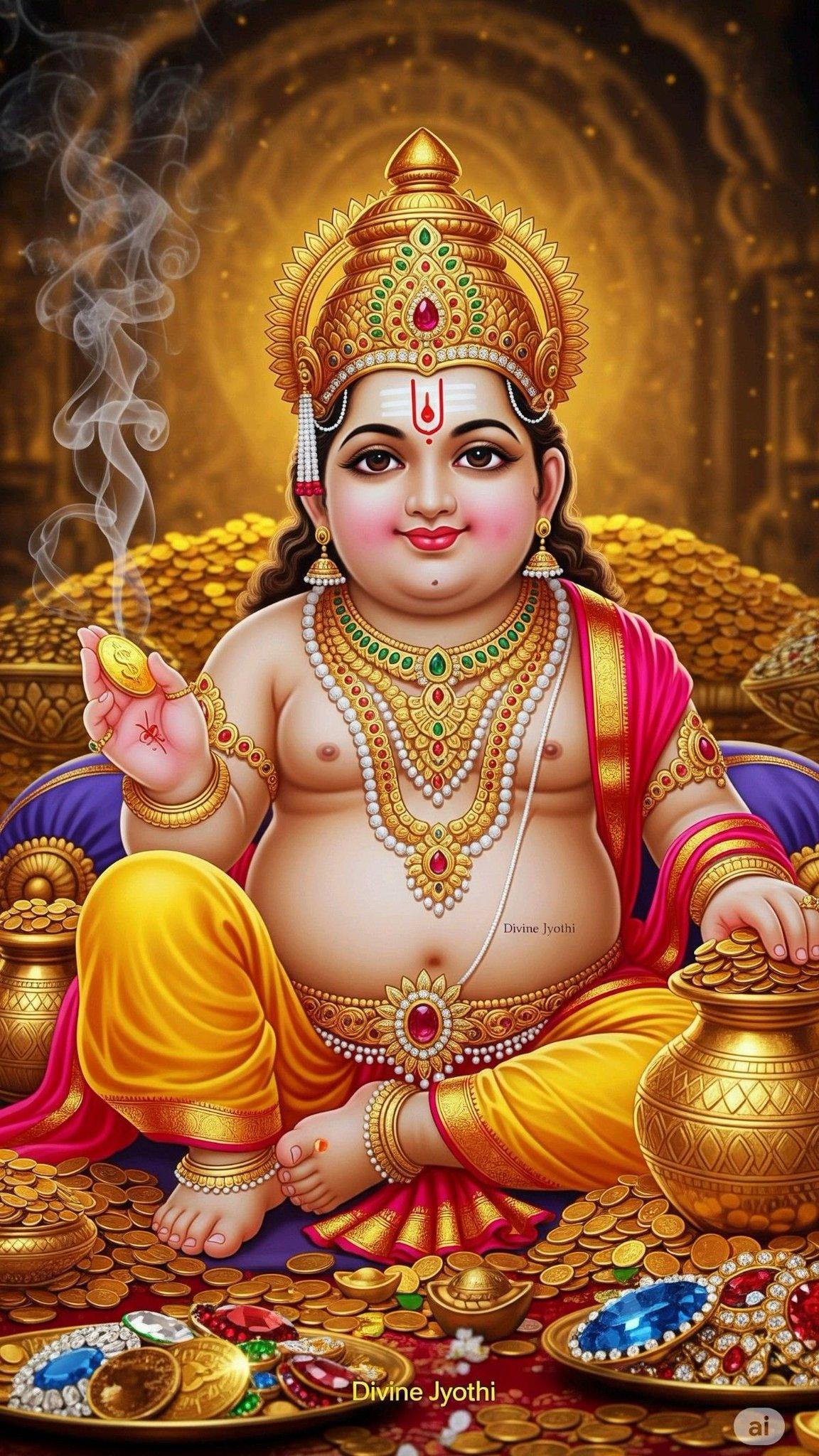
On the Top-Right side of the front wall, you can see Ganesh with his Consort and then Maha-Lakshmi and Kuber idols are also present. These three are considered as Gods of Luck.
Other Sculptures in Rani ki Vav
Dikpals (Guardians of Eight Directions) also appear on the walls of Rani ki Vav.
8 Vasus are present on the walls with human body and Cow head in folded hands (Namaskar position).
Nav graha are represented in a complete set, over Sheshshayi Vishnu on the Well Shaft. Sun (Surya), Moon (Chandra), Mercury (Budha also known as Grahpati), Venus (Shukra), Mars (Mangal), Jupiter (Brihaspati), Saturn (Shani), Rahu and Ketu constitute Nine Planets called Nav Graha.
Dikpal - Guardian of directionDikpal – Guardian of A Direction
A Marble sculpture of 48cm height was recovered while de-silting in 1987-88. This sculpture has an inscription in devnagari(indian script) “Maharajani Shri Udayamati”. Due to time constraints, we did not get a chance to see this sculpture. Hence, have no idea where it is kept (May be in museum).
Rani Ki Vav is built using burnt bricks, lime mortar, and locally available “Dhrangadhra” stone. Larger blocks of stones were joined by Rosewood Dowels and placed on the ground, forming the floor of the steps and terraces.
Interlocking system with woodInterlocking System With Wood
A small glass plate was attached at several places where cracks are visible. These cracks were developed after Bhuj’s Earthquake. Upon asking about the purpose of these glass plates, our guide told us they are attached to keep the track of changes in such sections. When the stress on such sections will be increased, these glass plates will break and give an indication for safety.
#thehinduheritage #CulturalHeritage
#thehindugodsandgoddesses #scrolllink #bharat













 Arabic
 French
 Spanish
 Portuguese
 Deutsch
 Turkish
 Dutch
Dutch
 Hindi
Hindi
 Italiano
 Russian
 Romaian
 Portuguese (Brazil)
 Greek
Greek