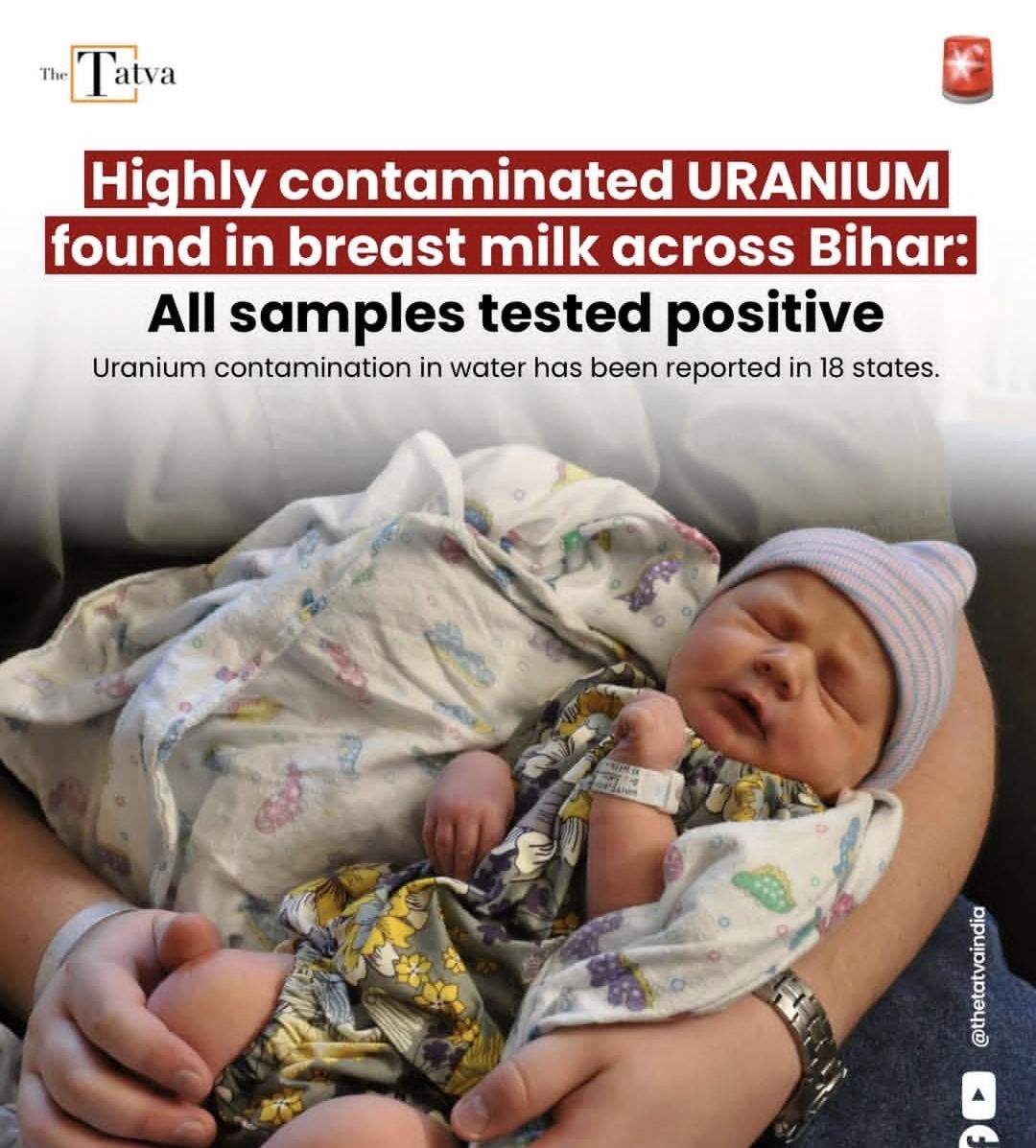



• A new scientific study has raised red flags over the presence of uranium in the breastmilk of lactating mothers across six districts of Bihar, indicating potential health risks for infants who rely exclusively on breastmilk during their early months of life.

    The research, published in Scientific Reports, is the first assessment of uranium contamination in breastmilk in the Gangetic plains of Bihar — a region already known for toxic exposure to heavy metals like arsenic, lead, and mercury.

    The researchers analysed breastmilk samples from 40 lactating mothers between 17 and 35 years of age, selected from Bhojpur, Samastipur, Begusarai, Khagaria, Katihar, and Nalanda.

    Every participant provided informed consent, and detailed interviews were conducted to understand breastfeeding practices, child growth, and residential history.

    The study was conducted by teams from Mahavir Cancer Sansthan & Research Centre (Patna), Lovely Professional University, NIPER-Hajipur, and other collaborating institutions.

    One of the most striking findings is stated clearly in the paper:
    “The present study reports 100% lactating mothers having their breastmilk highly contaminated with uranium.”

    #news #science #scrolllink
    A new scientific study has raised red flags over the presence of uranium in the breastmilk of lactating mothers across six districts of Bihar, indicating potential health risks for infants who rely exclusively on breastmilk during their early months of life. The research, published in Scientific Reports, is the first assessment of uranium contamination in breastmilk in the Gangetic plains of Bihar — a region already known for toxic exposure to heavy metals like arsenic, lead, and mercury. The researchers analysed breastmilk samples from 40 lactating mothers between 17 and 35 years of age, selected from Bhojpur, Samastipur, Begusarai, Khagaria, Katihar, and Nalanda. Every participant provided informed consent, and detailed interviews were conducted to understand breastfeeding practices, child growth, and residential history. The study was conducted by teams from Mahavir Cancer Sansthan & Research Centre (Patna), Lovely Professional University, NIPER-Hajipur, and other collaborating institutions. One of the most striking findings is stated clearly in the paper: “The present study reports 100% lactating mothers having their breastmilk highly contaminated with uranium.” #news #science #scrolllink
    wow
    Like
    Sad
    4
    0 Yorumlar 0 hisse senetleri 578 Views 0 önizleme
  • कॉलेज हमारा तो बच्चे भी हमारे ही पढ़ेंगे किसी मूला, मौलवी,हुलूलिया ईसाई को एक भी सीट नहीं देंगे

    श्री माता वैष्णव देवी मेडिकल कॉलेज में सीट के आवंटन को लेकर जम्मू के सनातनियों ने किया अपनी शक्ति का सामूहिक प्रदर्शन

    हिंदू एकता जिंदाबाद

    #vaishnoDevi #hindu #university #scrolllink
    कॉलेज हमारा तो बच्चे भी हमारे ही पढ़ेंगे किसी मूला, मौलवी,हुलूलिया ईसाई को एक भी सीट नहीं देंगे श्री माता वैष्णव देवी मेडिकल कॉलेज में सीट के आवंटन को लेकर जम्मू के सनातनियों ने किया अपनी शक्ति का सामूहिक प्रदर्शन हिंदू एकता जिंदाबाद 🔥💪 #vaishnoDevi #hindu #university #scrolllink
    Love
    wow
    2
    0 Yorumlar 1 hisse senetleri 308 Views 5 0 önizleme
  • #NewsLiveNow दिल्ली विस्फोट मामले की पड़ताल में फंसी अल-फलाह यूनिवर्सिटी की मान्यता रद्द कर दी गई

    #BreakingNews #DelhiBlast #RedFort #AlFalahUniversity
    #NewsLiveNow दिल्ली विस्फोट मामले की पड़ताल में फंसी अल-फलाह यूनिवर्सिटी की मान्यता रद्द कर दी गई #BreakingNews #DelhiBlast #RedFort #AlFalahUniversity
    Like
    wow
    5
    1 Yorumlar 0 hisse senetleri 416 Views 0 önizleme
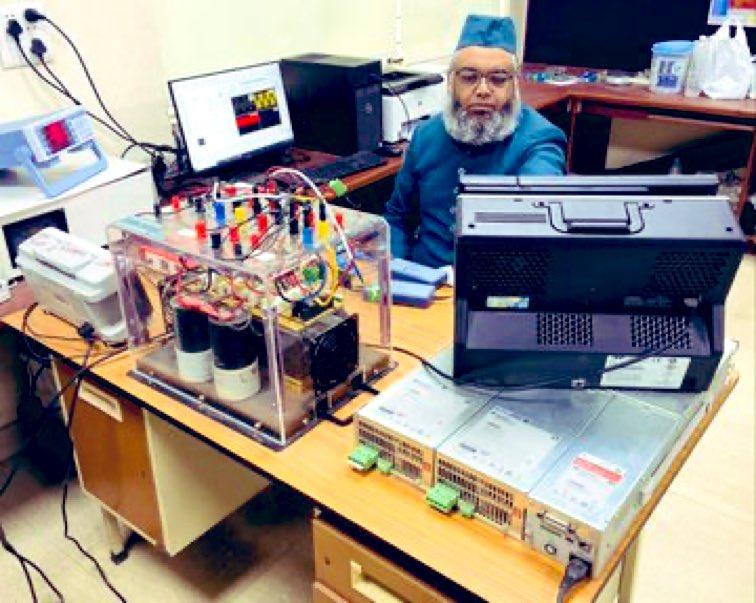
  • Engineer at Jamia Millia University

    क्या लगता है, क्या बनाएगा?


    #muslim #islam #jehadi #education
    Engineer at Jamia Millia University क्या लगता है, क्या बनाएगा? 🙈 #muslim #islam #jehadi #education
    Haha
    3
    1 Yorumlar 0 hisse senetleri 304 Views 0 önizleme
  • Mohammad Rafiq from Mewat knows everything about Gaza and Palestine, but nothing about the university now linked to the Red Fort blast in Delhi.

    Mohammad Rafiq from Mewat knows everything about Gaza and Palestine, but nothing about the university now linked to the Red Fort blast in Delhi.
    Love
    2
    1 Yorumlar 0 hisse senetleri 297 Views 1 0 önizleme
  • Your brain is a muscle of adaptation — and stress, in the right amount, is its workout. Moderate stress acts like resistance training for your mind, triggering the release of neurochemicals like norepinephrine and dopamine that enhance focus, learning, and memory. It pushes the brain to strengthen neural pathways and form new ones, improving its ability to handle future challenges.

    Studies from the University of California, Berkeley show that mild stress can boost neurogenesis — the growth of new brain cells — and improve cognitive flexibility, helping you think faster and make better decisions under pressure. The key lies in balance: while chronic stress damages the brain, controlled doses fuel mental resilience, motivation, and creativity.

    So instead of avoiding stress completely, embrace challenges that stretch your limits — a tough project, a workout, or learning something new. That’s how your brain stays young, adaptable, and ready for anything.

    #Neuroscience #BrainHealth #MentalHealthMatters #scrolllink
    Your brain is a muscle of adaptation — and stress, in the right amount, is its workout. Moderate stress acts like resistance training for your mind, triggering the release of neurochemicals like norepinephrine and dopamine that enhance focus, learning, and memory. It pushes the brain to strengthen neural pathways and form new ones, improving its ability to handle future challenges. Studies from the University of California, Berkeley show that mild stress can boost neurogenesis — the growth of new brain cells — and improve cognitive flexibility, helping you think faster and make better decisions under pressure. The key lies in balance: while chronic stress damages the brain, controlled doses fuel mental resilience, motivation, and creativity. So instead of avoiding stress completely, embrace challenges that stretch your limits — a tough project, a workout, or learning something new. That’s how your brain stays young, adaptable, and ready for anything. #Neuroscience #BrainHealth #MentalHealthMatters #scrolllink
    0 Yorumlar 0 hisse senetleri 893 Views 0 önizleme
  • Researchers have recorded the briefest interval of time ever measured: 247 zeptoseconds—the duration for a photon of light to traverse a hydrogen molecule.

    That's 0.000000000000000000247 seconds.A zeptosecond equals one trillionth of a billionth of a second, a realm where light, the universe's speed champion, advances mere fractions of an atomic diameter. For scale, a single second contains as many zeptoseconds as there are seconds in 31.7 trillion years—vastly exceeding the age of the cosmos.

    Physicist Reinhard Dörner and colleagues at Goethe University Frankfurt achieved this using intense X-rays from Hamburg's PETRA III accelerator. They aimed at hydrogen molecules—the simplest in existence, comprising two protons and two electrons. An incoming photon struck both electrons in rapid sequence, akin to a stone skipping across water.

    To resolve this fleeting event, the team employed a COLTRIMS reaction microscope, an ultra-precise instrument that tracks particle positions and momenta. By examining the interference patterns from the two expelled electrons, they pinpointed the precise lag between the photon's impact on the first electron and the second.The finding: 247 zeptoseconds.

    This demonstrates that light does not illuminate a molecule instantaneously, even at this tiny scale; the delay stems from light's finite velocity of roughly 186,000 miles per second (300,000 km/s). It represents the first direct observation of light propagating inside a molecule.

    By contrast, chemical reactions unfold over femtoseconds—a thousandfold longer. Zeptosecond precision opens a window into quantum timescales, where electron and photon dynamics govern matter's core behaviors.

    #zeptosecond #chemiclas #quantum #timescale #scrolllink
    Researchers have recorded the briefest interval of time ever measured: 247 zeptoseconds—the duration for a photon of light to traverse a hydrogen molecule. That's 0.000000000000000000247 seconds.A zeptosecond equals one trillionth of a billionth of a second, a realm where light, the universe's speed champion, advances mere fractions of an atomic diameter. For scale, a single second contains as many zeptoseconds as there are seconds in 31.7 trillion years—vastly exceeding the age of the cosmos. Physicist Reinhard Dörner and colleagues at Goethe University Frankfurt achieved this using intense X-rays from Hamburg's PETRA III accelerator. They aimed at hydrogen molecules—the simplest in existence, comprising two protons and two electrons. An incoming photon struck both electrons in rapid sequence, akin to a stone skipping across water. To resolve this fleeting event, the team employed a COLTRIMS reaction microscope, an ultra-precise instrument that tracks particle positions and momenta. By examining the interference patterns from the two expelled electrons, they pinpointed the precise lag between the photon's impact on the first electron and the second.The finding: 247 zeptoseconds. This demonstrates that light does not illuminate a molecule instantaneously, even at this tiny scale; the delay stems from light's finite velocity of roughly 186,000 miles per second (300,000 km/s). It represents the first direct observation of light propagating inside a molecule. By contrast, chemical reactions unfold over femtoseconds—a thousandfold longer. Zeptosecond precision opens a window into quantum timescales, where electron and photon dynamics govern matter's core behaviors. #zeptosecond #chemiclas #quantum #timescale #scrolllink
    0 Yorumlar 0 hisse senetleri 876 Views 0 önizleme