Before the Temples: The Panjurli Daiva of Tulunadu
"Paatri povonji, Daiva barpi. Mana povonji, miru barpi." (The oracle departs, the Daiva arrives. The human departs, the wild arrives.)
In the heart of Tulunadu, where the padi (ancient sacred grove) breathes with the spirits of the land, the air does not ask for devotion. It demands it. It is thick with the scent of wet bolpu (laterite soil) and the promise of the Kar (monsoon). Here, Bhakti is not a gentle prayer, it is a trembling surrender to a force as raw as the first thunderclap. Here, Bhakti is for Panjurli.
They do not believe in this Daiva (spirit deity). They know it. They feel it in the shiver that runs through the areca grove, in the fierce protectiveness that guards their threshold. Panjurli Daiva was not crafted by dreamers, but unleashed from the very sweat of the Divine, a primal roar given form. To offer Bhakti to Panjurli is to offer respect to the storm.
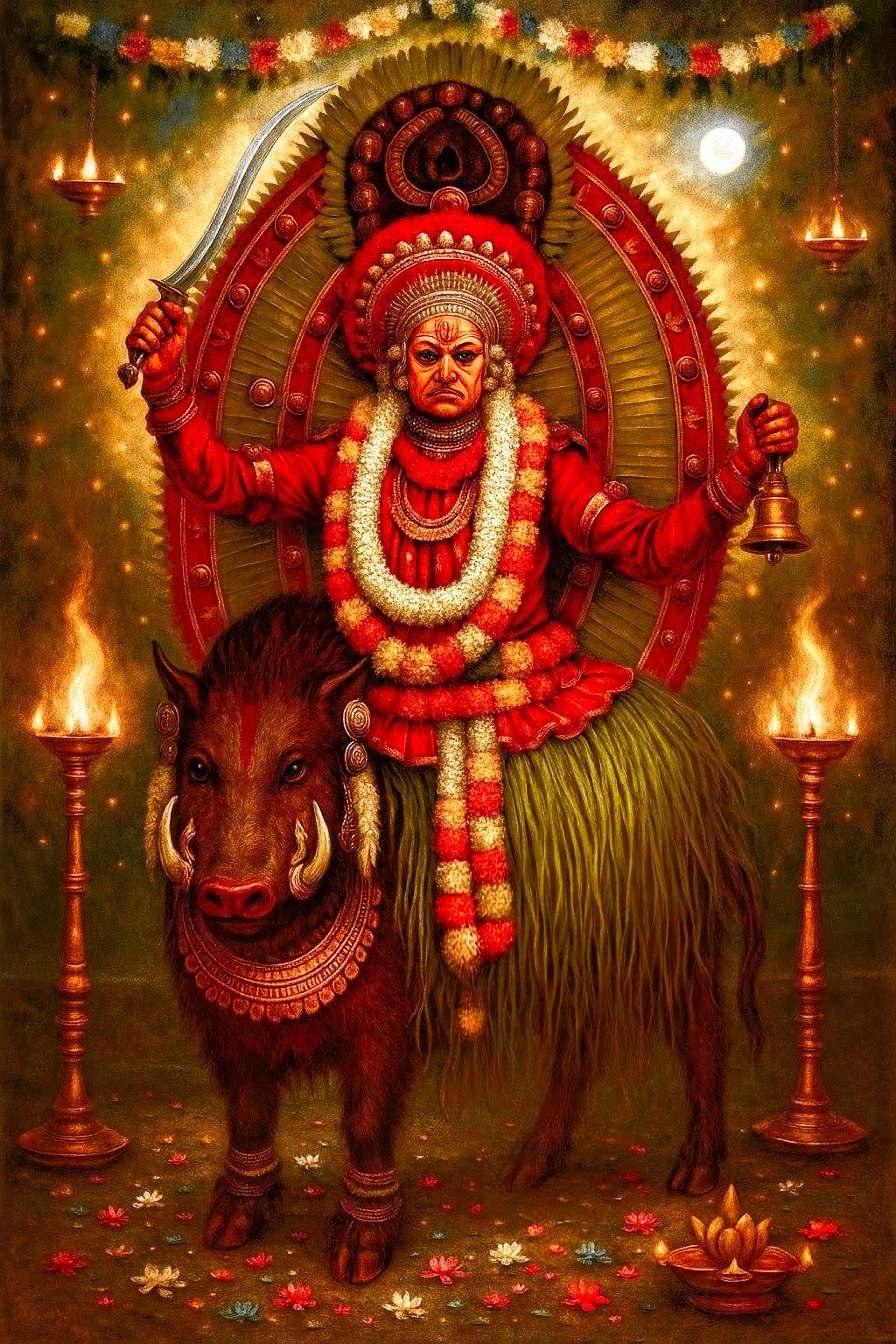
The Murti (sacred mask/idol) is their focal point. It is not a face, but a convergence of power. Forged in silver and gold, its boar visage is a permanent challenge, the kodu (tusks) not mere metal but instruments of divine surgery, meant to gore out the infection of dosha (sin/impurity). When the devotees, the saris, gather, their gaze is not one of adoration, but of awe struck vigilance.
When the drums (Dammamā) begin their frantic, heartbeat rhythm, it is not a call to prayer. It is a summons. The air thickens, heavy with the scent of crushed areca flowers and burning incense. The Paatri, the vessel, is no longer a man. He is a conduit. His body contorts, a puppet to a force that is anything but graceful. It is the brute, grounding shudder of the boar. His dance is not fluid, it is a powerful, stomping, a ritual of claiming territory, of shaking the very foundations of the human world to remind it of the wild one that lies beneath.
Panjurli does not whisper sweet promises. It speaks in a voice that is a low, guttural grunt, a gravelly torrent of truth. It is the voice of the land itself, judge, jury, and protector. It roots out deceit, exposes hidden sins, and enforces the sacred codes of the community. Its justice is not nuanced, it is as direct and unforgiving as a charging boar. To stand before Panjurli is to stand naked before the raw conscience of nature, stripped of all pretense.
This is not a god you love. This is a force you revere. A power you fear with a fear that is the beginning of wisdom. Panjurli is the spine chilling reminder that the land we build upon is alive, watching, and must be respected. It is the ancient, brute root that holds the community fast, lest it be washed away by the monsoon of its own transgressions.
"Mana bhakti botji ayi. Mana baka didi ayi." (Our devotion is a raw offering. Our prayer is a naked truth.)"
#pajurli #kantara #bhakti #scrolllinkBefore the Temples: The Panjurli Daiva of Tulunadu
"Paatri povonji, Daiva barpi. Mana povonji, miru barpi." (The oracle departs, the Daiva arrives. The human departs, the wild arrives.)
In the heart of Tulunadu, where the padi (ancient sacred grove) breathes with the spirits of the land, the air does not ask for devotion. It demands it. It is thick with the scent of wet bolpu (laterite soil) and the promise of the Kar (monsoon). Here, Bhakti is not a gentle prayer, it is a trembling surrender to a force as raw as the first thunderclap. Here, Bhakti is for Panjurli.
They do not believe in this Daiva (spirit deity). They know it. They feel it in the shiver that runs through the areca grove, in the fierce protectiveness that guards their threshold. Panjurli Daiva was not crafted by dreamers, but unleashed from the very sweat of the Divine, a primal roar given form. To offer Bhakti to Panjurli is to offer respect to the storm.
The Murti (sacred mask/idol) is their focal point. It is not a face, but a convergence of power. Forged in silver and gold, its boar visage is a permanent challenge, the kodu (tusks) not mere metal but instruments of divine surgery, meant to gore out the infection of dosha (sin/impurity). When the devotees, the saris, gather, their gaze is not one of adoration, but of awe struck vigilance.
When the drums (Dammamā) begin their frantic, heartbeat rhythm, it is not a call to prayer. It is a summons. The air thickens, heavy with the scent of crushed areca flowers and burning incense. The Paatri, the vessel, is no longer a man. He is a conduit. His body contorts, a puppet to a force that is anything but graceful. It is the brute, grounding shudder of the boar. His dance is not fluid, it is a powerful, stomping, a ritual of claiming territory, of shaking the very foundations of the human world to remind it of the wild one that lies beneath.
Panjurli does not whisper sweet promises. It speaks in a voice that is a low, guttural grunt, a gravelly torrent of truth. It is the voice of the land itself, judge, jury, and protector. It roots out deceit, exposes hidden sins, and enforces the sacred codes of the community. Its justice is not nuanced, it is as direct and unforgiving as a charging boar. To stand before Panjurli is to stand naked before the raw conscience of nature, stripped of all pretense.
This is not a god you love. This is a force you revere. A power you fear with a fear that is the beginning of wisdom. Panjurli is the spine chilling reminder that the land we build upon is alive, watching, and must be respected. It is the ancient, brute root that holds the community fast, lest it be washed away by the monsoon of its own transgressions.
"Mana bhakti botji ayi. Mana baka didi ayi." (Our devotion is a raw offering. Our prayer is a naked truth.)"
#pajurli #kantara #bhakti #scrolllink







 English
 Arabic
 Spanish
 Portuguese
 Deutsch
 Turkish
 Dutch
Dutch
 Hindi
Hindi
 Italiano
 Russian
 Romaian
 Portuguese (Brazil)
 Greek
Greek